Predictions
Interactive exercises to consolidate your students’ learning.
Predictions for the year ahead and how sure you are, with will definitely, will probably, might, probably won't and definitely won't, seen through two friends, Nia and Tom, who write predictions for the class time capsule in the first lesson of January. Pupils find the missing words, read the rule, tick the right words, change maybe sentences into sentences with might, put definitely and probably in the right place, write what a prediction machine says from its percentages and write five predictions of their own; answer key included. A sheet for the first lessons of January.
Documents to download (2)
- Colour version In your teacher account
- Black and white version In your teacher account
Teaching guide
Objective & content
This grammar sheet teaches how to make a prediction and say how sure you are: will definitely and definitely won't when you are 100% sure, will probably and probably won't when you are quite sure, might and might not when something is possible. It also shows where the adverb goes: after will but before won't (It will probably snow. It probably won't snow.). Pupils read a conversation in which Nia and Tom write predictions for the class time capsule in the first lesson of the year, find the missing words and read the rule, given in a box. By the end, they can make predictions about the year ahead and say how sure they are. No year is named, so the sheet suits the first lessons of January, every year.
Pedagogical guide
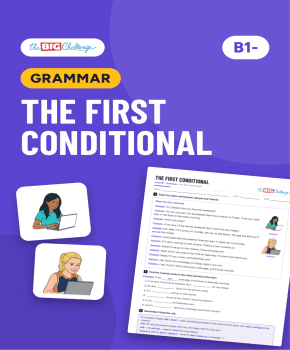
Page 1 is the conversation, with a picture of snow and of a phone: Tom says his football team will definitely win the school cup, and Nia answers that they probably won't; she will probably get a phone for her birthday and might pass her guitar exam; Tom thinks it will probably snow in January, and Nia says Mr Hall definitely won't give less homework. Pupils find five missing words in sentences from the conversation. Then they read the rule, given in a box in six short lines with the key words in bold: will + verb and won't, the forms for 100% sure, quite sure and possible, the place of definitely and probably, and no -s and no to on the verb after will and might. Page 2 has eight sentences where pupils tick the right words: five open with how sure the speaker is ("I'm 100% sure.", "It's possible, but I'm not sure.") and only one option has that meaning, and three test the form. Then pupils say five Maybe sentences again with might or might not, and write five sentences again with definitely or probably in the right place. Page 3 is the prediction machine: Robo-Predict gives a percentage for each prediction, a table gives the form for each number (100%, 80%, 50%, 20%, 0%), and pupils write six predictions with the verb in brackets. Last, they write five predictions about their own year for a time capsule. Every exercise opens with a worked example, except this free writing.
Suggested procedure
- (5 min) Ask the class "Will it snow this month?" and write definitely, probably and might on the board.
- (10 min) Two pupils read the conversation aloud; the class finds the missing words.
- (5 min) Read the rule in the box with the class; pupils find an example of each line in the conversation.
- (15 min) Page 2: pupils tick the right words, change the Maybe sentences and put definitely and probably in the right place.
- (10 min) Page 3: the prediction machine, then the five predictions for the time capsule.
- (5 min) Check with the answer key on page 4.
Adaptations
[S] Pupils read the conversation aloud in pairs, one as Nia and one as Tom, before the tasks.
[A] Pupils write three more predictions about the school.
Materials & prerequisites
One copy of pages 1 to 3 per pupil. Page 4 is the answer key and teacher notes: keep it. The key accepts short and full forms ('ll or will, won't or will not). Pupils need will and won't for predictions, and the words for school, sport and the weather. To take it further, make a real class time capsule in January: each pupil's five predictions go in an envelope, and the class opens it in the last week of the year.
Possible adaptations
- Lower levels: Offer segmented listening and additional visual aids.
- Advanced levels: Encourage an oral summary and a debate in English on the theme.
- Large groups: Organise group work with differentiated roles.
🔒 Restricted content
This resource requires a subscription to be viewed.
Unlock the resourceIncluded in the subscription