The past perfect
Interactive exercises to consolidate your students’ learning.
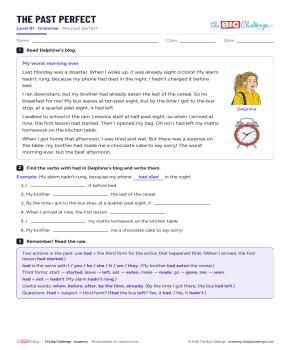
The past perfect with had + the third form for the action that happened first, with hadn't, questions with Had and short answers, seen through Delphine's blog about her worst morning ever. Pupils find the verbs with had, read the rule, say which action happened first, write had + the third form, make sentences negative, give short answers, put the events of Delphine's day in order, join them with when, before or by the time and write about a bad morning of their own; answer key included.
Documents to download (2)
- Colour version In your teacher account
- Black and white version In your teacher account
Teaching guide
Objective & content
This grammar sheet teaches the past perfect: had + the third form (had left, had eaten) for the action that happened first when two actions are in the past, hadn't, questions with Had ...? and short answers, with when, before, after, by the time and already. Pupils read Delphine's blog about her worst morning ever, find the verbs with had and read the rule, given in a box. By the end, they can tell a story in the past and show which action happened first.
Pedagogical guide
Page 1 is the blog, with a picture of Delphine and of an alarm clock: her phone had died in the night, so her alarm hadn't rung; her brother had already eaten the last of the cereal; by the time she got to the bus stop, the bus had left; and she had left her maths homework on the kitchen table. Pupils find six verbs with had in sentences from the blog. Then they read the rule, given in a box in short lines with the key words in bold: had + the third form for the action that happened first, the same had with every person, six third forms, hadn't, the useful words and questions with Had. Page 2 has six sentences with two past actions, where pupils tick the one that happened first, seven verbs in brackets to write with had + the third form (two of them negative, one with already), three wrong sentences about the blog to make negative, and three questions about the blog to answer with short answers. Page 3 is a puzzle in two parts: pupils put eight events of Delphine's day in order (the times in the blog give one order only), then join two events in one sentence with when, before or by the time, using had for the event that happened first. The last task is to write about a bad morning, true or invented, with three verbs with had. Every exercise opens with a worked example, except the writing task.
Suggested procedure
- (5 min) Tell the class "When I got to the station, my train had left" and ask: what happened first?
- (10 min) Read the blog aloud; pupils find the verbs with had.
- (5 min) Read the rule in the box with the class; pupils find a sentence in the blog with when, with by the time and with already.
- (15 min) Page 2: what happened first, had + the third form, then the negatives and the short answers.
- (15 min) Page 3: the puzzle, then the bad morning.
- (5 min) Check with the answer key on pages 4 and 5.
Adaptations
[S] Pupils read the blog aloud before the tasks and answer: what time did Delphine wake up? Why was there no breakfast?
[A] Pupils read their bad morning to a partner, who finds the verbs with had.
Materials & prerequisites
One copy of pages 1 to 3 per pupil. Pages 4 and 5 are the answer key and teacher notes: keep them. The key accepts hadn't and had not, and the two halves of a puzzle sentence in either order. Pupils need the past simple of regular and irregular verbs, the third forms of common verbs and the time. To take it further, pupils turn their bad morning into a comic strip of six pictures, with a caption with had under three of them.
Possible adaptations
- Lower levels: Offer segmented listening and additional visual aids.
- Advanced levels: Encourage an oral summary and a debate in English on the theme.
- Large groups: Organise group work with differentiated roles.
🔒 Restricted content
This resource requires a subscription to be viewed.
Unlock the resourceIncluded in the subscription