A phone call
Interactive exercises to consolidate your students’ learning.
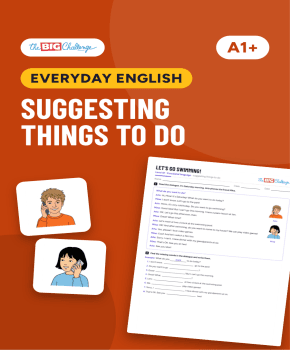
Inviting a friend on the phone and finding a day that works, in a two-page pack: six words to label (mobile phone, calendar, camera, coat, zoo, lion), the phrases to start a call, invite and ask and understand the answers, a dialogue to complete, the Listen Up! episode "A phone call" (a QR code on the sheet plays it) and a role-play. Answer page included, in colour and in black and white. For A1+, one lesson of about 50 minutes.
Documents to download (2)
- Worksheet In your teacher account
- Worksheet (black and white) In your teacher account
Teaching guide
Objective & content
A two-page pack for one everyday situation: inviting a friend on the phone and finding a day that works. Pupils learn the words (mobile phone, calendar, camera, coat, zoo, lion) and the phrases to start a call (Hi, it's Jack.), invite and ask (Do you want to come? What time? What's your address?) and understand the answers (Yes, please! Sorry, I can't. I have a swimming lesson. What about Sunday?). Then they hear the same language in a real conversation, the Listen Up! episode "A phone call", and use it themselves in a role-play. By the end, they can invite a friend on the phone, find a day and a time, and ask for an address.
Pedagogical guide
Page 1 is the language of the situation. Pupils talk about a picture of a boy on the sofa at home, talking to a friend on his phone, write six words under new drawings (the first is done), read a box of useful phrases (what you say or ask, and what you hear), and match five questions to their answers. Page 2 puts the language to work. Pupils complete a short dialogue with words from a box (Jack, who phones Mia to invite her to the beach), then listen to the episode: Chloe invites Sami to the zoo for her birthday, but he has a football match on Saturday, so they go on Sunday. A QR code on the sheet plays the recording on a phone or a tablet, with no app and no login. Pupils tick true or false, listen again for four short answers, then do a role-play with A and B cards: a pupil phones a friend to invite them to the swimming pool. Card B holds the information card A needs, so pupils have to ask. Every task opens with an example. Page 1 and the dialogue use other names, places and prices, so they never give away a listening answer. Page 3 is the answer key with the teacher notes.
Suggested procedure
- (5 min) Pupils look at the picture on page 1 and say where the people are and what they are doing.
- (5 min) Pupils write the words under the pictures; check together.
- (5 min) Pupils read the useful phrases aloud in pairs, one asking and one answering.
- (5 min) Pupils match the questions to the answers.
- (5 min) Page 2: pupils complete the dialogue with the words in the box.
- (10 min) Play the episode once for true or false, then again for the short answers.
- (10 min) Role-play in pairs with card A and card B, then pupils swap cards.
- (5 min) Check the answers with page 3.
Adaptations
[S] Pupils read the useful phrases aloud in pairs before the role-play, and keep page 1 in front of them while they play it. [A] Pupils invent their own problem in the same place and act it out without the cards.
Materials & prerequisites
One copy of pages 1 and 2 per pupil; cut out the role cards on page 2. Page 3 is the answer key: keep it. To play the episode, pupils scan the QR code with a phone or a tablet, or you play it to the class from the app (Listen Up!, "A phone call"). Pupils need days of the week, telling the time, and numbers for an address.
Possible adaptations
- Lower levels: Offer segmented listening and additional visual aids.
- Advanced levels: Encourage an oral summary and a debate in English on the theme.
- Large groups: Organise group work with differentiated roles.
🔒 Restricted content
This resource requires a subscription to be viewed.
Unlock the resourceIncluded in the subscription