Just in time
Interactive exercises to consolidate your students’ learning.
Time words at B2: by the time + past simple, then had + third form, and by then; in time against on time; at the end of against in the end; during + noun against while + subject + verb; within and throughout; at the time against at the moment; from ... onwards; after and before + verb-ing. Pupils read a dialogue between three friends about a concert the night before, find the missing words, read the rule, tick the sentence that means the same, tick the right word, say sentences again with the words given, circle the right words in a message and write three true sentences about a time they were late; answer key included.
Documents to download (2)
- Colour version In your teacher account
- Black and white version In your teacher account
Teaching guide
Objective & content
This grammar sheet takes the time words one step further, after the B1 sheet Wake me up on Friday. It teaches by the time + past simple, then had + third form (By the time we got to the hall, the first band had finished), and by then; in time (early enough) against on time (at the planned time); at the end of against in the end (finally); during + noun against while + subject + verb; within and throughout (within an hour, throughout the concert); at the time (then) against at the moment (now); from ... onwards; and after and before + verb-ing. Pupils read a dialogue between Freya, Jodie and Megan: on Friday morning at school, Freya and Jodie tell Megan about the concert they went to the night before. They find the missing words and read the rule, set out in a chart. By the end, they say which of two past events came first, keep on time for the planned time, and stop writing during we were waiting and after to wait.
Pedagogical guide
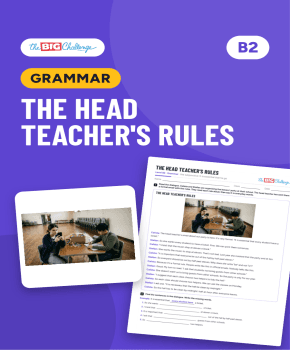
The sheet works on the order of events and on pairs that look alike (in time and on time, at the end of and in the end, during and while). Page 1 is the dialogue, with a photo of the scene and five sentences to complete. Page 2 opens with the rule chart (six rows: the words, what they mean, an example), then works on meaning (exercise 4: four sentences, tick the one of two sentences that means the same) and on form (exercise 5: six items, three options each, where the words around the gap decide). Page 3 opens with the chart of four usual mistakes (during we were waiting, in the end of the concert, Until the time we arrived, it had started, After to wait for an hour, we left). Pupils then say five sentences again with the words in brackets (exercise 7), circle the right words in Jodie's message to Freya's mum (exercise 8: nine brackets, the first one done as an example) and write three true sentences about a time they were late, or nearly late (exercise 9). Exercises 2, 4, 5 and 7 open with a worked example.
Suggested procedure
- (5 min) Write The first band finished at 8.00. We got to the hall at 8.10. on the board. Ask pupils how to say it in one sentence; collect ideas and keep the sentences for step 3.
- (10 min) Read the dialogue aloud; pupils find the missing words in the five sentences (exercise 2).
- (5 min) Read the rule chart with the class. Come back to the board and turn the sentences into By the time we got to the hall, the first band had finished. Pupils say which thing came first.
- (15 min) Page 2: exercises 4 and 5.
- (15 min) Page 3: the chart of mistakes, then exercises 7 and 8.
- (5 min) Check exercises 2, 4, 5, 7 and 8 with the answer key on page 4. Pupils can do exercise 9 at home.
Adaptations
[S] Pupils read the dialogue aloud in threes before they look for the missing words.
[A] In groups, pupils tell the story of an evening that went wrong (a missed bus, a lost ticket) in six sentences with by the time, in time, at the end of, in the end and while.
Materials & prerequisites
One copy of pages 1 to 3 per pupil, in colour or in black and white. Page 4 is the answer key and teacher notes: keep it. Pupils need the present simple and continuous, the past simple and continuous, the past perfect, going to and the present continuous for a plan, at, on and in for time, by, until, for and during, clock times, and a few words for a concert (band, main act, crowd, exit).
Curriculum alignment
The French lycée programme (2025) lists "time markers (ago, for, since)" in its grammar list at A2+, "Wider time markers (when, while, as soon as, in the meantime)" at B1 and a "Very wide range of time markers (whilst, once, formerly)" at B2; it does not list the prepositions of time as an item of their own, since they are expected well before. The sheet goes beyond these lists: it adds by the time with the past perfect, in time against on time, at the end of against in the end, within, throughout and from ... onwards.
Possible adaptations
- Lower levels: Offer segmented listening and additional visual aids.
- Advanced levels: Encourage an oral summary and a debate in English on the theme.
- Large groups: Organise group work with differentiated roles.
🔒 Restricted content
This resource requires a subscription to be viewed.
Unlock the resourceIncluded in the subscription