The head teacher's rules
Interactive exercises to consolidate your students’ learning.
The subjunctive after words of necessity and request, a formal written form: It is essential that every student have a ticket, I insist that the music stop, with be staying be, not + verb for the negative, and the everyday way to say the same thing with want + person + to or should. Pupils read a dialogue between two friends who organise a leavers' party and read the head teacher's formal email of rules, find the missing words, read the rule, decide between a rule and a fact, tick the formal form, say formal sentences in everyday English, write a formal email from notes and write three rules of their own; answer key included.
Documents to download (2)
- Colour version In your teacher account
- Black and white version In your teacher account
Teaching guide
Objective & content
This grammar sheet teaches the subjunctive after words of necessity and request, a formal written form: It is essential that every student have a ticket, I insist that the music stop. The verb keeps its simple form (no -s, no to), be stays be, the negative is not + verb, and the same form is used in the past. It also gives the everyday way to say the same thing, with want + person + to or should. Pupils read a dialogue between Calista and Stellan, who are organising the leavers' party at their school and reading the head teacher's formal email of rules, find the missing words and read the rule, set out in a chart. By the end, they can recognise the formal form, turn it into everyday English and back, and they stop adding an -s in a formal rule.
Pedagogical guide
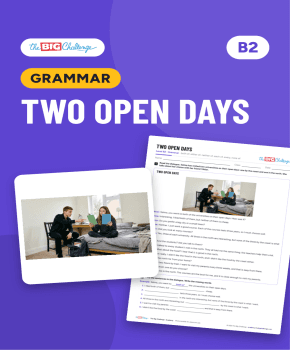
The sheet works on one idea: the formal form and the everyday way say the same thing, and pupils learn to go from one to the other. Page 1 is the dialogue, with a photo of the scene and five sentences to complete. Page 2 opens with the rule chart (six rows: the form, what to remember, an example), then works on meaning (exercise 4: four pairs of sentences, a rule or a fact, tick the one that means the same) and on the formal form (exercise 5: four items, where the words before the gap decide). Page 3 opens with the chart of four usual mistakes (has with a singular subject, is for be, I suggest him to stop, don't for not). Pupils then turn four formal sentences into everyday English (exercise 7), read the head teacher's notes in a table (exercise 8, five rows; NO means she does not want it), write her formal sentences from the notes (exercise 9, four items) and write three formal rules of their own (exercise 10). Every exercise opens with a worked example. Every task that asks for the form says "formal" in its instruction line, because in everyday British English people often say I suggest that he stops: tell pupils that the sheet teaches the formal, written form.
Suggested procedure
- (5 min) Write It is essential that every student have a ticket. on the board. Ask what looks odd; pupils say what they would expect (has). Do not correct yet: keep the sentence for step 3.
- (10 min) Read the dialogue aloud; pupils find the five missing words (exercise 2).
- (5 min) Read the rule chart with the class. Come back to the sentence on the board and ask why have is right. Pupils then use the last row to say one everyday sentence with want + person + to and one with should.
- (15 min) Page 2: exercises 4 and 5.
- (15 min) Page 3: the chart of mistakes, then exercises 7, 8 and 9.
- (5 min) Check exercises 2, 4, 5, 7 and 9 with the answer key on page 4. Pupils can do exercise 10 at home.
Adaptations
[S] Pupils read the dialogue aloud in pairs before they look for the missing words; one reads the email in a very formal voice.
[A] In pairs, pupils write a formal email of six rules for a school trip, then swap and say each rule in everyday words.
Materials & prerequisites
One copy of pages 1 to 3 per pupil, in colour or in black and white. Page 4 is the answer key and teacher notes: keep it. Pupils need the present simple and the past simple, should, and want + person + to, and a few words for school life (leavers' party, head teacher, tidy, guests, helpers).
Curriculum alignment
French lycée programme (2025), grammar list at B2: "Subjunctive", with the example "It is essential that they be equal". The programme names the form only; the sheet adds the everyday way to say the same thing.
Possible adaptations
- Lower levels: Offer segmented listening and additional visual aids.
- Advanced levels: Encourage an oral summary and a debate in English on the theme.
- Large groups: Organise group work with differentiated roles.
🔒 Restricted content
This resource requires a subscription to be viewed.
Unlock the resourceIncluded in the subscription