Who is who?
Interactive exercises to consolidate your students’ learning.
Complex noun phrases and compound adjectives, for saying who is who: two 's in a row (my dad's sister's husband), 's on a whole group (the bride and groom's car), 's alone for somebody's home (at my aunt and uncle's), 's or of (the end of the evening), and compound adjectives with a number or with -ed (a three-year-old boy, a five-hour party, a grey-haired man). Pupils read a dialogue between two friends at a wedding party, complete the sentences, read the rule, tick the sentence that says what a phrase means, tick the right words, say sentences again with the words given, circle the right words in a message and write three sentences about their own family or friends; answer key included.
Documents to download (2)
- Colour version In your teacher account
- Black and white version In your teacher account
Teaching guide
Objective & content
This grammar sheet teaches complex noun phrases and compound adjectives, for saying who is who in a family. Two 's in a row are read from the end (my dad's sister's husband); one 's after the last word shows what two people own together (the bride and groom's car); 's alone stands for somebody's home (at my aunt and uncle's); people take 's and things usually take of (the end of the evening). Compound adjectives are built with a number (a three-year-old boy, a five-hour party: hyphens, no plural s) or with -ed (a grey-haired man). Pupils read a dialogue between Layla and Tara at the party after Layla's cousin's wedding, complete the sentences and read the rule, set out in a chart. By the end, they read and build long noun phrases from the end, and write compound adjectives with hyphens and no plural s.
Pedagogical guide
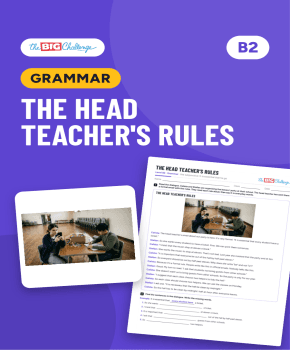
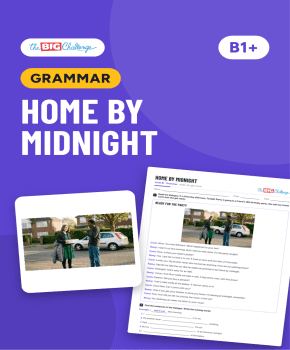
The sheet works on one idea: a long phrase is built from the end; the last word is the person or thing, and everything before it tells you more. Page 1 is the dialogue, with a picture of the scene and six sentences to complete (exercise 2). Page 2 opens with the rule chart (six rows: the form, what it means, an example), then works on meaning (exercise 4: five phrases, tick the sentence that says what the phrase means) and on form (exercise 5: seven items with three options each, where the sentence before the gap decides). Page 3 opens with the chart of four usual mistakes (a three-years-old boy, the wedding of the cousin of Layla, the bride's and groom's car, my dad sister's husband). Pupils then say five sentences again, starting with the words given (exercise 7), circle the right words in Tara's message to her mum (exercise 8: eight choices, the first one done as an example) and write three sentences about their own family or friends (exercise 9). Exercises 2, 4, 5, 7 and 8 each open with a worked example.
Suggested procedure
- (5 min) Write my dad's sister's husband on the board. Ask who this man is for the speaker; collect ideas and keep the phrase for step 3.
- (10 min) Read the dialogue aloud, or ask two pupils to read Tara and Layla; pupils complete the six sentences (exercise 2).
- (5 min) Read the rule chart with the class. Come back to the phrase on the board and read it from the end: the husband, of the sister, of my dad. In pairs, one pupil says a phrase with two 's and the other says who the person is.
- (15 min) Page 2: exercises 4 and 5.
- (15 min) Page 3: the chart of mistakes, then exercises 7 and 8.
- (5 min) Check exercises 2, 4, 5, 7 and 8 with the answer key on page 4. Pupils can do exercise 9 at home.
Adaptations
[S] Pupils read the dialogue aloud in pairs and underline every 's and every hyphen before they complete the sentences.
[A] In pairs, pupils draw the family tree of an invented family and ask each other who is who, with at least five phrases with two 's.
Materials & prerequisites
One copy of pages 1 to 3 per pupil, in colour or in black and white. Page 4 is the answer key and teacher notes: keep it. Pupils need the present simple, the present continuous, will and the past simple, and a few words for a family and a wedding (aunt, uncle, cousin, grandson, bride, groom).
Curriculum alignment
French lycée programme (2025), grammar list at B2: "complex noun phrases (Mary's daughter's baby)", an example the sheet takes up in exercise 5. The 2025 programmes already list "compound adjectives (a black-haired man)" at B1, which the sheet takes up in the last two rows of its rule chart.
Possible adaptations
- Lower levels: Offer segmented listening and additional visual aids.
- Advanced levels: Encourage an oral summary and a debate in English on the theme.
- Large groups: Organise group work with differentiated roles.
🔒 Restricted content
This resource requires a subscription to be viewed.
Unlock the resourceIncluded in the subscription