Who is it?
Interactive exercises to consolidate your students’ learning.
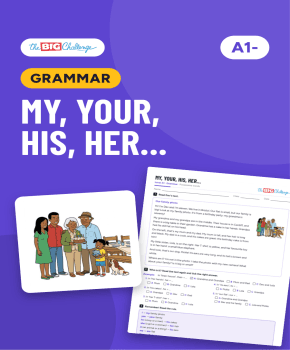
Him, her, it and them, his and her: the words that tell us who we are talking about. Pupils meet a family in pictures (Wilbur, Nell, baby Sam, Granny, Grandpa and Barney the dog), read short sentences and circle who each word stands for, read the his and her rule and circle the right word, then draw a person they love and write two lines about them. Answer key and teacher notes included.
Documents to download (2)
- Colour version In your teacher account
- Black and white version In your teacher account
Teaching guide
Objective & content
This activity sheet is about the small words that tell us who we are talking about: him, her, it and them after a verb, and his and her before a noun. Pupils meet one family in pictures (Wilbur, Nell, baby Sam, Granny, Grandpa and Barney the dog), read short sentences about them and find the person or the thing each word stands for. They then learn when to say his and when to say her, and use the words once in their own writing. By the end, pupils understand Nell gives him a teddy. (him = baby Sam) and say his kite for Wilbur and her book for Nell.
Pedagogical guide
The sheet asks pupils to understand the words first and to produce them only at the end. Task 1 shows the six members of the family with their names: say them together. Task 2 gives six pairs of short sentences, such as "Baby Sam is sad. Nell gives him a teddy." Pupils circle who him is, from two choices; only one fits, because him is a boy or a man, her a girl or a woman, it a thing or the dog, and them two or more. The pattern (he → him, she → her, it → it, they → them) is in the title of the task. Task 3 is the rule for his and her, shown with the family's pictures (Wilbur's kite → his kite; Nell's book → her book), and task 4 asks pupils to circle his or her four times. Task 5 is a drawing of a person they love, with two sentence starters (This is ..., I love ...). Page 2 gives the answer key and the teacher notes.
Suggested procedure
- (5 min) Pass classroom objects around: "Give it to him! Give it to her! Give them to me!" Pupils act it out.
- (5 min) Task 1: say the names of the family together; pupils point at each person.
- (10 min) Task 2: read the pattern in the title, then the six items; pupils circle who each word is. Check together.
- (5 min) Tasks 3 and 4: read the rule with the pictures, then pupils circle his or her.
- (10 min) Task 5: pupils draw a person they love and finish the two sentences.
Adaptations
[S] Read each item of task 2 aloud and point at the two pictures before pupils circle.
[A] Pupils write two more lines about the family, for example "Barney loves Grandpa. He runs to him."
Materials & prerequisites
One copy per pupil of page 1, in colour or black and white. Pupils need a pencil and colours for the drawing. Page 2 is the answer key with teacher notes: keep it. Pupils should already know he, she, it and they and the family words granny and grandpa; every person on the sheet is shown with a picture and a name.
Possible adaptations
- Lower levels: Offer segmented listening and additional visual aids.
- Advanced levels: Encourage an oral summary and a debate in English on the theme.
- Large groups: Organise group work with differentiated roles.
🔒 Restricted content
This resource requires a subscription to be viewed.
Unlock the resourceIncluded in the subscription