Who cut that hair?
Interactive exercises to consolidate your students’ learning.
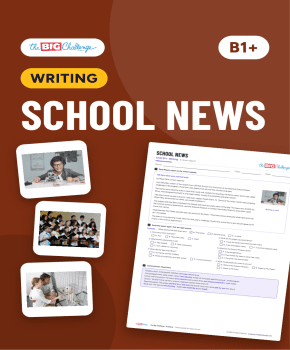
Relative clauses beyond who and that: whose + a noun (the boy whose hair looks like a bowl), extra information between commas with who or which, never that (Mr Hale, who taught us maths, ...), and the relative word left out (the boy you sat next to). Pupils read a dialogue in which two friends go through an old class photo, find the missing words, read the rule, choose who, whose or which, join sentences with whose, add information between commas, tick the right sentence and write about the photo from a table, then write about their own class; answer key included.
Documents to download (2)
- Colour version In your teacher account
- Black and white version In your teacher account
Teaching guide
Objective & content
This grammar sheet teaches three steps beyond who and that in relative clauses: whose + a noun (the boy whose hair looks like a bowl), extra information between commas with who or which, never that (Mr Hale, who taught us maths, ...), and the relative word left out when no verb follows it (the boy you sat next to). Pupils read a dialogue between Lucian and Oona, two 17-year-olds who go through their class photo from when they were eleven, find the missing words and read the rule, given in a chart. By the end, they can choose who, whose or which and decide when commas are needed, and they stop writing the boy who his bag is open.
Pedagogical guide
The sheet asks two questions before each choice: does a noun belong to the person or thing before the gap (whose), and are there commas around the clause (who or which, never that)? Page 1 is the dialogue, with a photo of the scene and five sentences to find, all copied from the text. Page 2 opens with the rule chart. Pupils then choose who, whose or which in six items, join four pairs of sentences with whose, and put three pieces of information between commas with who or which. Page 3 opens with a chart of five usual mistakes (who his, who's for whose, that after a comma, the word left out before a verb, what as a relative). Pupils then tick the right sentence of two in three items, read a table about four people in the photo, use it to write five sentences, and write three sentences about their own class at eleven, with a starter. Every exercise opens with a worked example. The sheet uses the present simple and continuous, the past simple, the superlative, can / could and one present perfect with ever, with no conditional, no passive and no past perfect. It leaves out whom, where and when as relatives, of which, and a preposition before the relative (the boy next to whom I sat).
Suggested procedure
- (5 min) Write the boy whose hair looks like a bowl on the board. Ask pupils what a class photo from age eleven shows, and which words they would use to point at one face.
- (10 min) Read the dialogue aloud in pairs; pupils find the five missing sentences (exercise 2).
- (5 min) Read the rule chart on page 2 with the class: whose, then the clauses with and without commas.
- (15 min) Page 2: exercises 4, 5 and 6.
- (10 min) Page 3: the chart of mistakes, exercise 8, then the table and exercise 10.
- (5 min) Check with the answer key on page 4. Pupils can write exercise 11 at home.
Adaptations
[S] Pupils read the dialogue aloud in pairs before they look for the missing sentences.
[A] Pupils describe an old class photo of their own, with whose and with who between commas.
Materials & prerequisites
One copy of pages 1 to 3 per pupil, in colour or in black and white. Page 4 is the answer key and teacher notes: keep it. Pupils need who, which and that in simple relative clauses, the possessives his, her, its and their, and the past simple of common verbs.
Curriculum alignment
French lycée programme (2025): the grammar list for the B1+ target names "complex relative pronouns (whose, who / whom)". The sheet covers whose and who and which with and without commas; whom is left for a later level.
Possible adaptations
- Lower levels: Offer segmented listening and additional visual aids.
- Advanced levels: Encourage an oral summary and a debate in English on the theme.
- Large groups: Organise group work with differentiated roles.
🔒 Restricted content
This resource requires a subscription to be viewed.
Unlock the resourceIncluded in the subscription