Remarkable women
Interactive exercises to consolidate your students’ learning.
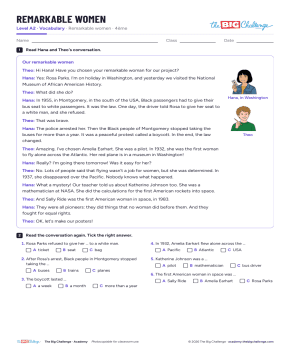
Hana and Theo each choose a remarkable woman for a class project: Rosa Parks and the bus boycott, the pilot Amelia Earhart, the NASA mathematician Katherine Johnson and the astronaut Sally Ride. Pupils answer questions, label pictures from their stories, match meanings, match each woman with her story, complete sentences and find a mystery word; answer key included.
Documents to download (2)
- Colour version In your teacher account
- Black and white version In your teacher account
Teaching guide
Objective & content
This sheet on remarkable women starts from a conversation between Hana, on holiday in Washington, and Theo, who are each choosing a woman for a class project. Hana tells the story of Rosa Parks: in 1955, in Montgomery, the law said that black passengers had to give their bus seat to white passengers; she refused, and the peaceful bus boycott that followed changed the law. Theo chooses the pilot Amelia Earhart, and they add the NASA mathematician Katherine Johnson and the astronaut Sally Ride. Pupils learn to tell the story of a person's life and say why they admire them. They answer six multiple-choice questions, label six pictures from the women's stories with words from a box of eight, match eight words such as brave, boycott and pioneer with their meanings, match the four women with their stories and complete eight sentences from a box of ten words. The sheet ends with a mystery word: seven clues spell PIONEER.
Pedagogical guide
The conversation carries the words of the topic, so pupils meet each one in context before working on it. Rosa Parks's story is told as a biography: the unfair law is stated as a fact of its time, together with the peaceful protest that changed it; keep the class talk on the facts and on her courage. There are no pictures of real people: the pictures show objects from the women's stories (a bus seat, a red plane, a rocket). There is no word-form task on this sheet: matching each woman with her story does that work. The tasks go from recognising words to using them, and the last task is the hardest: each clue points back to the conversation. Every task tests words, never grammar. The facts are checked: the boycott lasted more than a year, and Amelia Earhart flew alone across the Atlantic in 1932.
Suggested procedure
- (5 min) Ask "Which women do you admire?" and write their names and what they did on the board.
- (10 min) Two pupils read the conversation aloud; the class answers the six questions.
- (8 min) Pupils label the six pictures, then match the eight words with their meanings.
- (5 min) Pupils match the four women with their stories.
- (8 min) Pupils complete the sentences with the words in the box.
- (9 min) Pupils read the clues and find the mystery word.
- (5 min) Check with the answer key on page 4.
Adaptations
[S] Pupils name a woman they admire, from history or today, before reading.
[A] Pupils write a five-sentence biography of a remarkable woman of their choice. To take it further, the class makes a gallery of posters, one woman each.
Materials & prerequisites
One copy of the three pupil pages per pupil, in colour or in black and white. Page 4 is the answer key: keep it. Pupils should know the past simple, the present perfect, had to, and the first woman to.
Possible adaptations
- Lower levels: Offer segmented listening and additional visual aids.
- Advanced levels: Encourage an oral summary and a debate in English on the theme.
- Large groups: Organise group work with differentiated roles.
🔒 Restricted content
This resource requires a subscription to be viewed.
Unlock the resourceIncluded in the subscription