What's the word?
Interactive exercises to consolidate your students’ learning.
What to do when you don't know a word: say it another way. A French boy staying with his English friend needs a towel, a pillow and a charger, and describes each one (It's a thing for drying your body. It's like a long white snake.). Pupils read the dialogue, find his sentences, read the strategy in a chart, write six descriptions, then play Don't say the word! in pairs; answer key included.
Documents to download (2)
- Colour version In your teacher account
- Black and white version In your teacher account
Teaching guide
Objective & content
This sheet teaches pupils to go on talking when they don't know a word. Léo, from France, is staying with his English friend Tom and needs three things he cannot name: he describes them, and Tom understands at once. Pupils learn five ways to describe a thing: It's a thing for + -ing, You use it to + verb, It's like a ..., what it looks like, and where you find it. By the end, they can describe an everyday thing so that a partner finds it.
Pedagogical guide
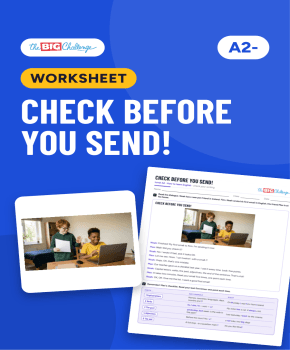
Page 1 is the dialogue, with a photo of the two boys: Léo needs a towel (It's a big thing for drying your body), a pillow (It's soft, and you put your head on it) and a charger (It's like a long white snake). Pupils find five of his sentences and write the missing words. Page 2 opens with the strategy in a chart, one line for each way to describe. Pupils then write six descriptions from the words in brackets (a ruler, a phone, a hotel, a hairbrush, a key, a tent); the first one is done. The sheet ends with a pair game, Don't say the word!: eight picture cards, each with two helping words; one pupil describes a card in secret, the partner finds it.
Suggested procedure
- (5 min) Describe a thing in the classroom without its name (You use it to open the door). Pupils guess.
- (10 min) Pupils read the dialogue in pairs, then do exercise 2.
- (5 min) Page 2: read the chart with the class.
- (10 min) Exercise 4: pupils write the six descriptions.
- (10 min) Exercise 5: the pair game. Pupils swap after each card.
- (5 min) Check exercises 2 and 4 with the answer key on page 3.
Adaptations
[S] In the game, pupils may use the two helping words on the card and read from the chart.
[A] Make it a class habit: a pupil who doesn't know a word says I don't know the word in English and describes it; nobody gives the word in another language.
Materials & prerequisites
One copy of pages 1 and 2 per pupil, in colour or in black and white. Page 3 is the answer key and teacher notes: keep it. Pupils need the present simple, can and the past simple of a few common verbs (forgot, understood). The sheet uses a thing for + -ing and you use it to, not relative clauses.
Curriculum alignment
French collège programme (2025), common preamble: pupils build "transferable strategies such as memorising, inference, planning, compensation, checking and self-correction". This sheet works on compensation. The sheet is one of six "How to learn English" sheets, one strategy each; it fits any class at this level, in any country.
Possible adaptations
- Lower levels: Offer segmented listening and additional visual aids.
- Advanced levels: Encourage an oral summary and a debate in English on the theme.
- Large groups: Organise group work with differentiated roles.
🔒 Restricted content
This resource requires a subscription to be viewed.
Unlock the resourceIncluded in the subscription