Say it in English! The cinema and the café (Italian edition)
A teaching resource designed to energise your English lessons.
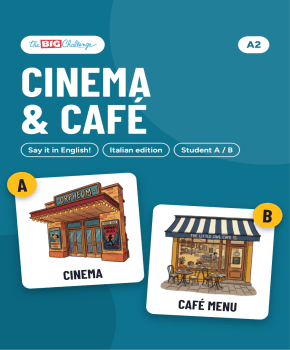
Cross-language mediation pair work in two rounds, for Italian-speaking classes: the documents are in Italian, and pupils explain them in English to a partner who plays an English-speaking exchange student. Round 1: a cinema programme; round 2: a café menu with allergens. The pupil with the document must not translate it all, only pass on what the visitor needs, and the visitor decides. Practises It says ..., It's on at ..., It's in English with Italian subtitles, It costs ... and It's got nuts in it. 3 pages: Student A, Student B, teacher page with the answer key. About 25 minutes.
Documents to download (1)
- Pair work: Student A, Student B, key In your teacher account
Teaching guide
Objective & content
A cross-language mediation pair activity in two rounds, for Italian-speaking classes. It is sheet 3 of the "Say it in English!" set. The documents are in Italian; everything pupils say and write is in English. In round 1, Student A has an Italian cinema programme, and Student B plays Sam, a 13-year-old English exchange student who wants to see a film on Saturday, in English, must be home for dinner at 19:00, loves sport and has €8. In round 2, Student B has an Italian café menu, and Student A plays Alex, 15, who wants lunch, is allergic to nuts, doesn't eat meat and has €9. The pupil with the document must not translate it all: they explain only what the visitor needs, and the visitor decides. By the end, pupils can pick out the useful facts in an Italian document and pass them on simply in English.
Pedagogical guide
This is the CEFR's cross-language mediation: explaining a document in your own language to someone who doesn't speak it. The rule on each page is the heart of the task: "Your partner doesn't speak Italian. Don't translate everything: tell them only what they need, in English." Each document holds more than the visitor needs, so the explainer listens to the task and selects. The phrases box gives It says ..., It's on at ..., It's in English with Italian subtitles, It costs ..., It's got nuts in it and This one is good for you, because .... Pupils also meet everyday words they will need abroad: film, subtitles, under 14, finishes at, lunch menu, drink, dessert, nuts, meat, allergic to. Two words in the document are really essential: "originale sott. ita" (in English with subtitles) and "frutta a guscio" (nuts): the pupil has to find a simple way to say them in English. In round 1, Space Rescue is in English but finishes too late; Sam is under 14, so he pays €5. Shadow House is 14+ in the Italian ratings, so it is out for Sam. Each task has one best answer. Page 3 is the teacher page: the idea, four steps, the language and the key with the reasons.
Suggested procedure
One activity of about 25 minutes.
- (3 min) Set up the pairs: copy page 1 (Student A) for half the class and page 2 (Student B) for the other half, and put pupils in A + B pairs, face to face. Nobody shows their page. Read the rule and the phrases box with the class.
- (8 min) Round 1: B is Sam, reads the task and asks; A explains the Italian cinema programme in English. B writes the film, the day and time, the price and why it is good for Sam.
- (8 min) Round 2: A is Alex, reads the task and asks; B explains the Italian menu in English. A writes the lunch, the drink, the dessert and the price.
- (6 min) Pairs swap pages and check, then tell the class who chose what and why. Check with the key on page 3.
Adaptations
[S] Before round 1, the class finds the English words for the column headings together.
[A] Pupils bring a real cinema programme or menu from their town and explain it to a partner in the same way.
Materials & prerequisites
Print infogap.pdf: page 1 for Student A and page 2 for Student B, one copy per pupil; page 3 is the teacher page. Pupils need a pencil. They should already know days, times, prices, food and film types, and present simple questions. It goes well with work on free time or food, and with the other "Say it in English!" and "Explain it to me!" sheets.
Possible adaptations
- Lower levels: Offer segmented listening and additional visual aids.
- Advanced levels: Encourage an oral summary and a debate in English on the theme.
- Large groups: Organise group work with differentiated roles.
🔒 Restricted content
This resource requires a subscription to be viewed.
Unlock the resourceIncluded in the subscription