Reading A2: Which Animal Sleeps the Most?
Interactive exercises to consolidate your students’ learning.
An A2 reading about sleep: koalas sleep up to 22 hours a day and little brown bats almost 20, cats and dogs more than we do, wild sloths less than people think, and wild elephants only two hours. One text with a word box, ten questions and a group survey, who sleeps the most?, plus an answer key; 30 to 40 minutes.
Documents to download (2)
- Reading comprehension In your teacher account
- Reading comprehension (black and white) In your teacher account
Teaching guide
Objective & content
An A2 reading about sleep, which starts with the pupils themselves: teenagers need eight to ten hours a night. Koalas sleep 18 to 22 hours a day, because eucalyptus leaves give them little energy, and a little brown bat studied in 1969 slept almost 20 hours. Cats and dogs sleep 12 to 16 hours, so pets probably sleep more than their owners. A surprise follows: sloths were thought to sleep 16 hours, but only zoo sloths had been studied; in 2008, wild sloths in Panama slept about nine and a half hours. In 2017, wild elephants in Botswana slept only two hours a day, often standing up. By the end, pupils can follow a short informative text, find facts and numbers, and compare with "the most" and "the least". It is part of the Reading A2 set: one-text readings with the same layout.
Pedagogical guide
The sheet has one text of about 260 words at A2, with short sentences of 13 words or fewer, and a word box with six words explained in English (hardly, eucalyptus, energy, hunt, sensor, lazy). The ten questions go from finding information to giving an opinion: three choices, true or false and one gap to complete first, then "Why did people think that sloths slept 16 hours a day? Explain using the text." and "How many hours do you sleep? Is it enough?" The text uses the superlative ("which animal sleeps the most, the least") and "as lazy as", with the present simple for facts and the past simple for the studies. The speaking task is a class survey: in groups, pupils ask about bedtimes and hours of sleep and report who sleeps the most and the least. Every fact comes from published studies, Guinness World Records and pet-care references.
Suggested procedure
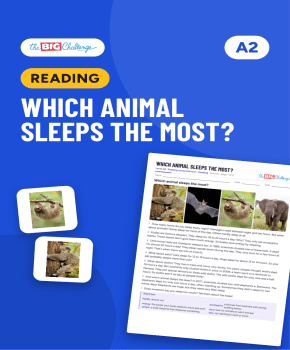
- (5 min) Warm-up: show the photos and ask "Which of these animals sleeps the most, do you think?"
- (10 min) Pupils read the text alone. They can use the word box.
- (10 min) Pupils answer questions 1 to 10, then check in pairs. Correct together with the key; for 9 and 10, take two or three answers.
- (10 to 15 min) Speaking task: in groups, pupils ask "What time do you go to bed?" and "How many hours do you sleep?", then tell the class who sleeps the most and who sleeps the least in their group.
Adaptations
[S] Go through the word box first, with the photos. Before question 9, read paragraph 5 again together. Pupils can answer questions 1 to 8 only, and ask one question in the survey.
[A] Pupils turn the group's answers into a bar chart and write three sentences with "the most", "the least" and "more than". They can also rank all the animals of the text, from the longest sleeper to the shortest.
Materials & prerequisites
The sheet in colour or low ink (the low-ink version has no pictures), one copy per pupil: pages 1 and 2 are for pupils, page 3 is the answer key. A screen to show the photos for the warm-up. Pupils should know the present simple, the past simple and numbers.
Possible adaptations
- Lower levels: Offer segmented listening and additional visual aids.
- Advanced levels: Encourage an oral summary and a debate in English on the theme.
- Large groups: Organise group work with differentiated roles.
🔒 Restricted content
This resource requires a subscription to be viewed.
Unlock the resourceIncluded in the subscription