Some, any, much and many
Interactive exercises to consolidate your students’ learning.
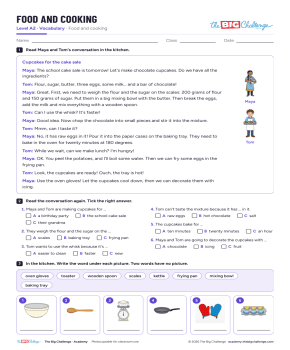
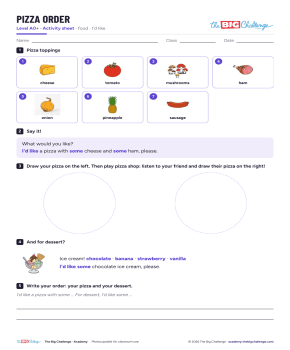
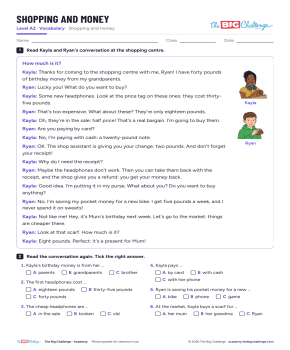
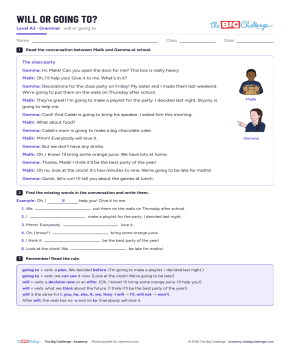
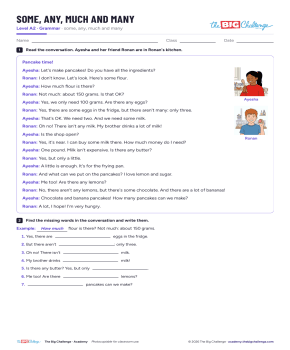
Some, any, much, many and a lot of, with things we can count and things we can't count, seen through a conversation between Ayesha and Ronan, who want to make pancakes. Pupils find the missing words, read the rule, choose a, an or some, some or any, much or many, ask How much and How many, and solve a picnic puzzle; answer key included.
Documents to download (2)
- Colour version In your teacher account
- Black and white version In your teacher account
Teaching guide
Objective & content
This grammar sheet teaches some, any, much, many and a lot of: things we can count (eggs, lemons) and things we can't count (flour, milk, money), a or an and some, and the questions How many? and How much?. Pupils read a conversation between Ayesha and Ronan, who want to make pancakes in Ronan's kitchen, find the missing words and read the rule, given in a box. By the end, they can say what there is and what there isn't, and ask about quantities and prices.
Pedagogical guide
Page 1 is the conversation, with a picture of Ayesha and of Ronan: there isn't much flour, there aren't many eggs, there isn't any milk, and there are a lot of bananas. Pupils find seven missing words in sentences from the conversation. Page 2 has the rule, given in a box in short lines (some in positive sentences, any in negatives and questions, many and much, a lot of, How many? and How much?, and How much is it? for a price), eight sentences to complete with a, an or some, six sentences where pupils tick some or any, and six where they tick much, many or a lot of. Page 3 has five questions to complete with How much or How many, then a picnic puzzle: four friends each brought one thing (juice, cheese, sandwiches, apples, shown in pictures). Pupils use three clues to fill a grid, write what each friend brought with some and answer three questions. Every exercise opens with a worked example.
Suggested procedure
- (5 min) Show a bag of shopping or a picture of a fridge and ask "Is there any milk? How many eggs are there?"
- (10 min) Read the conversation aloud; pupils find the missing words.
- (5 min) Read the rule in the box with the class; pupils find examples of it in the text.
- (10 min) Page 2: a, an or some, then the two tick tasks.
- (5 min) Page 3: How much or How many.
- (10 min) The picnic puzzle: pupils fill the grid in pairs, then write and tick the answers.
- (5 min) Check with the answer key on page 4.
Adaptations
[S] Pupils read the conversation aloud in pairs, one as Ayesha and one as Ronan, before the tasks.
[A] Pupils look in their kitchen at home and write four sentences with some, any, much and many.
Materials & prerequisites
One copy of pages 1 to 3 per pupil. Page 4 is the answer key and teacher notes: keep it. Pupils need there is and there are, questions and negatives in the present simple, and the words for food and drinks. To take it further, pairs play "Shopping list": one pupil asks "Are there any...?" or "How much... is there?", the other answers from a secret list.
Possible adaptations
- Lower levels: Offer segmented listening and additional visual aids.
- Advanced levels: Encourage an oral summary and a debate in English on the theme.
- Large groups: Organise group work with differentiated roles.
🔒 Restricted content
This resource requires a subscription to be viewed.
Unlock the resourceIncluded in the subscription