Sound Check: the letter i
Interactive exercises to consolidate your students’ learning.
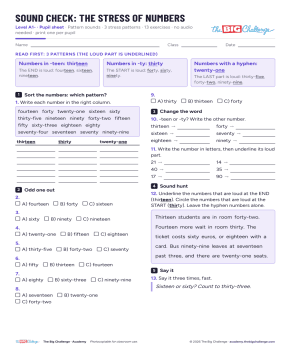
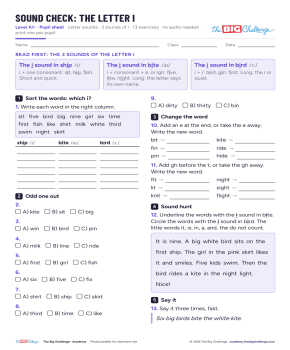
A one-page Sound Check sheet on the three regular sounds of the letter i (ship, bite, bird), decided from the spelling alone: sort 18 words into three columns, find the odd one out, change the word (bit/bite), then underline and circle the sounds in a short text. No audio and no cutting: a pupil does it alone, as homework. Teacher sheet with the key and notes.
Documents to download (3)
- Pupil sheet In your teacher account
- Teacher sheet (answer key) In your teacher account
- Colour version In your teacher account
Teaching guide
Objective & content
Pupils read the letter i and decide, from the spelling alone, which of its three regular sounds it makes: i as in ship (i + one consonant), i as in bite (i + consonant + e, or igh) and i as in bird (i + r). One A4 pupil sheet: the three sounds as cards at the top, then sort 18 words into three columns, eight odd-one-out sets, two change-the-word blocks (bit/bite, fit/fight), a short text to underline and circle by sound, and one line to read aloud. One teacher sheet with the answer key and notes.
Pedagogical guide
The Sound Check units and their card decks work by ear. This sheet works by eye, so it needs no audio, no cutting and no partner: a pupil can do it alone, at home, and check it against the key. Every word on it follows a regular spelling pattern, so the answer is always on the page. The irregular spellings are kept off the sheet on purpose and named in the teacher notes as exceptions for later. Filed at A1-, the level where the patterns are first needed. The words themselves are not capped at that level: a pupil does not have to know a word or its meaning, only to read its spelling, so a rarer word with a regular pattern is a fair example.
Suggested procedure
- (2 min) Read the three cards at the top aloud, or let pupils read them at home.
- (10 min) Pupils work alone: sort, odd one out, change the word, sound hunt.
- (3 min) Check with the key. Ask which words were hard to place and why.
- (1 min) Everyone says the read-aloud line three times, fast.
Adaptations
- [S] Do the sort together first, one word at a time, before pupils try the rest alone.
- [A] Cover the three cards and ask pupils to write the rule for each column themselves.
- Homework: hand out the pupil sheet only; mark from the teacher sheet the next day, or print the key for self-checking.
Materials & prerequisites
One pupil sheet per pupil, one teacher sheet. No audio. Pupils should be able to read the 18 words of the sort; the Sound Check units on ship and sheep and on pen and pin are an optional lead-in.
Curriculum alignment
France: the phonological and spelling work of the cycle 3 and cycle 4 programmes (linking spelling to sound, discriminating the vowels of English). The three i patterns are the first spelling-to-sound work of cycle 3 and cycle 4 (discriminating and producing the vowels of English). Tags: short-vowels, long-vowels, diphthongs, silent-e, minimal-pairs.
Assessment & extensions
The sort and the sound hunt are the check: a pupil who places the 18 words and marks the text correctly reads the three patterns. Extend with the Sound Cards decks for the same sounds, or with the other letter sheets of the series (a, e, i, o, u).
Possible adaptations
- Lower levels: Offer segmented listening and additional visual aids.
- Advanced levels: Encourage an oral summary and a debate in English on the theme.
- Large groups: Organise group work with differentiated roles.
🔒 Restricted content
This resource requires a subscription to be viewed.
Unlock the resourceIncluded in the subscription