Spot the difference: my bedroom
A teaching resource designed to energise your English lessons.
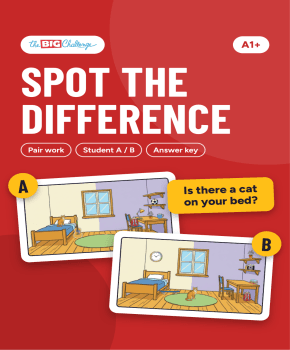
Pair work on a drawn bedroom: half the class are Student A, half are Student B, and each describes their room without showing it. The two rooms differ in 8 ways (3 things moved, 3 different things, 2 missing) and pupils circle the differences on their own page. Practises There's a ... on / under / next to my ..., Is there a ...? and Where's your ...?. 3 pages: Student A, Student B, teacher page with the answer key. About 15 to 20 minutes.
Documents to download (1)
- Colour version In your teacher account
Teaching guide
Objective & content
A spot-the-difference pair activity on a drawn bedroom. Half the class are Student A and half are Student B; both pages show the same empty room, but the things in it are different in exactly 8 ways: 3 things moved, 3 different things and 2 things missing. Pupils describe their room without showing it ("There's a lamp on my desk.", "Is there a cat on your bed?", "Where's your plant?") and circle the differences on their own page. By the end, pupils can say where things are with on, under and next to, and ask and answer with there is.
Pedagogical guide
The pupils must listen, because the only way to find a difference is to compare what they hear with their own picture. The questions box on each page gives three question frames with model answers and a sentence to start with. The language is There's a ... on / under / next to my ..., Is there a ...? Yes, there is. / No, there isn't. and Where's your ...? It's ..., with the places the bed, the desk, the chair, the rug, the shelf and the wall. The set is A1+ because next to sits on the A1+ floor. Page 3 is the teacher page: four steps, both rooms with each difference ringed and numbered, and a table of the 8 differences.
Suggested procedure
One activity of about 15 to 20 minutes.
- (3 min) Set up the pairs: copy page 1 (Student A) for half the class and page 2 (Student B) for the other half, and put pupils in A + B pairs, face to face. Nobody shows their page.
- (4 min) Read the questions box with the class and point at on, under and next to. Model the first question with one pupil: "Is there a cat on your bed?" "No, there isn't."
- (10 min) Pairs describe their rooms and ask questions. Each pupil circles the differences in his or her own room. Walk round and listen for the prepositions.
- (3 min) Pairs swap pages and check that they found all 8 differences, then check with the key on page 3.
Adaptations
[S] Write on, under and next to on the board with a small drawing of each, and let pupils read the sentence to start with from the page. Pairs may point at the place on their page without showing the picture, then say the sentence.
[A] Pupils draw a room with five things in it. Their partner listens and draws it without looking: "There's a ball under my desk."
Materials & prerequisites
Print infogap.pdf: page 1 for Student A and page 2 for Student B, one copy per pupil; page 3 is the teacher page. Pupils need a pencil or a coloured pen to circle the differences. They should already know there is / there isn't, the names of the things in a bedroom and the words on and under. It goes well after a lesson on the house and furniture, and before any work on describing places.
Possible adaptations
- Lower levels: Offer segmented listening and additional visual aids.
- Advanced levels: Encourage an oral summary and a debate in English on the theme.
- Large groups: Organise group work with differentiated roles.
🔒 Restricted content
This resource requires a subscription to be viewed.
Unlock the resourceIncluded in the subscription