Street art
Interactive exercises to consolidate your students’ learning.
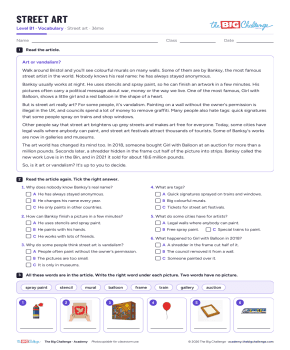
Banksy, stencils and spray paint: the article "Art or vandalism?" gives both sides of the street art debate, from illegal tags to legal walls and the shredded Girl with Balloon. Pupils name pictures, match meanings and collocations, complete sentences, make person nouns with -er and end on a mystery word; answer key included.
Documents to download (2)
- Colour version In your teacher account
- Black and white version In your teacher account
Teaching guide
Objective & content
This sheet on street art opens on a magazine article, "Art or vandalism?", that gives both sides of the debate. It presents Banksy, the anonymous street artist from Bristol who works with stencils and spray paint, explains that painting on a wall without permission is illegal, and shows the other side: legal walls, street art festivals and Girl with Balloon, half of which a shredder hidden in its frame cut into strips at an auction in 2018. The article carries every word of the tasks, from mural, stencil and anonymous to vandalism, permission, graffiti and auction. By the end, pupils understand and use the words of street art and give an opinion on the debate ("I think it's...", "It's illegal, but...").
Pedagogical guide
The vocabulary work comes out of the article, never from a list. Banksy's works are named but never reproduced: the pictures show tools and everyday objects. Page 1 checks understanding with six multiple-choice questions, then pupils name six pictures from a box of eight words in the article (spray paint, stencil, frame). Page 2 matches eight words such as political, illegal and a tag with their meanings, then six collocations (break the law, ask for permission, change your mind). Page 3 uses eight words in new sentences, with two extra words in the box, and turns five verbs into person nouns with -er (own, owner), with a worked example. It ends on a mystery word: pupils write six words from clues, and the shaded boxes spell the name of the artist. It is the hardest task, as pupils must recall each word and spell it correctly. Every task tests words, never grammar. The sheet fits the cycle 4 theme "Langages".
Suggested procedure
- (5 min) Ask "Is graffiti art?"; show a street art photo from your town if there is one.
- (10 min) Pupils read the article, answer the six questions and name the pictures.
- (10 min) Page 2: match the meanings, then the collocations.
- (10 min) Page 3: complete the eight sentences, then make the five person nouns with -er.
- (10 min) Pupils solve the mystery word from the clues.
- (10 min) Correct with the answer key on page 4; end on a quick class vote: "Art or vandalism?", each pupil giving one reason.
Adaptations
[S] Read the article aloud together first; show a street art photo from your town if there is one.
[A] After the collocations, pupils write four sentences: two arguments for street art and two against. To take it further, the class holds a debate, or pupils design a stencil with a message for their school.
Materials & prerequisites
One copy of the three pupil pages per pupil, in colour or in black and white. Page 4 is the answer key with teacher notes: keep it. Pupils should know the past simple, the present perfect, relative clauses with where and modals such as can.
Possible adaptations
- Lower levels: Offer segmented listening and additional visual aids.
- Advanced levels: Encourage an oral summary and a debate in English on the theme.
- Large groups: Organise group work with differentiated roles.
🔒 Restricted content
This resource requires a subscription to be viewed.
Unlock the resourceIncluded in the subscription