Short story: The Monkey's Paw
Interactive exercises to consolidate your students’ learning.
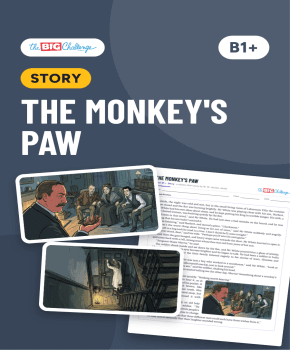
W. W. Jacobs's famous horror story The Monkey's Paw (1902), retold at B1+ with the story untouched: a dried paw that grants three wishes comes to a quiet family, and each wish comes true in the worst way. The horror is implied, never shown. Four pages of story with pictures, then six choice questions, three "Think about it" questions on fate and the ending, a box and gap fill on the passive and the second conditional, and a pair writing task; answer key and teacher notes included, in colour and in black and white. One long lesson or two short ones.
Documents to download (2)
- Worksheet In your teacher account
- Worksheet (black and white) In your teacher account
Teaching guide
Objective & content
W. W. Jacobs's famous horror story The Monkey's Paw (1902), retold at B1+. The language is simplified, the story is not. An old soldier brings the White family a dried monkey's paw: a holy man put a spell on it, and three men can each have three wishes. The Whites laugh and wish for two hundred pounds. The money comes, in the worst possible way. The horror stays implied: no death is shown. By the end, pupils can follow a story of about 1,750 words, discuss fate and the ending with reasons, and use the passive and the second conditional from the story.
Pedagogical guide
The story runs over four pages, set like a novel, with one drawing on each page. Page 5 holds the tasks. Six choice and true or false questions check the story, from why the soldier threw the paw into the fire to what Mr White's third wish probably was. Three "Think about it" questions ask for reasons: how the story shows that fate controls people's lives, whether the paw killed Herbert or it was an accident, and why the writer never tells us what was outside the door. A box gives two structures from the story (was / were + past participle, and if + past simple, would + verb), then pupils complete four sentences from the story. In the last task, pupils work in pairs: each writes three wishes, and the partner writes how each wish could go wrong. Page 6 is the answer key with the teacher notes.
Suggested procedure
- (5 min) Ask "If you could have three wishes, what would you wish for?" and keep a few answers on the board.
- (20 min) Read the story aloud, or pupils read in pairs. Stop after "Two hundred pounds." and ask "Is it the paw?" Stop again after "the top bolt began to move." and ask "What will Mr White wish?"
- (10 min) Pupils answer the choice questions; check together.
- (10 min) Pupils discuss the "Think about it" questions in groups, then share their reasons.
- (10 min) Pupils read the box and complete the four sentences.
- (10 min) In pairs, pupils write three wishes and how each could go wrong, using the wishes on the board.
Adaptations
[S] Read the story over two lessons, two pages at a time, and go through the words they may need first (spell, fate, machinery, cemetery, bolt). Pupils can answer the choice questions and one "Think about it" question.
[A] Pupils write the last scene again from Mrs White's point of view, or a new ending in which Mr White does not make the third wish.
Materials & prerequisites
One copy per pupil, in colour or black and white: pages 1 to 5 are for pupils, page 6 is the answer key. Pupils should know the past simple, the past continuous and the past perfect, and have met the passive.
Possible adaptations
- Lower levels: Offer segmented listening and additional visual aids.
- Advanced levels: Encourage an oral summary and a debate in English on the theme.
- Large groups: Organise group work with differentiated roles.
🔒 Restricted content
This resource requires a subscription to be viewed.
Unlock the resourceIncluded in the subscription