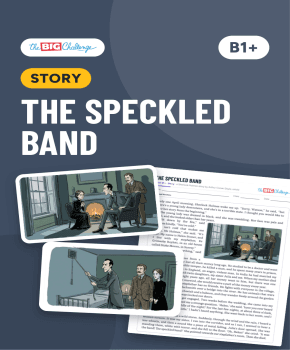
Short story: The Speckled Band
Interactive exercises to consolidate your students’ learning.
The Speckled Band by Arthur Conan Doyle (1892), the most famous locked-room mystery of Sherlock Holmes, retold at B1+ with the story untouched: a frightened young woman comes to Baker Street at dawn. Two years ago her sister died in the night, in a locked room, crying "The speckled band!" Now she sleeps in the same bed, and she has heard the same low whistle. Holmes finds three strange things in the room, and spends a long night in the dark to see what comes. Four pages of story with pictures, then six choice questions, "Find the clues" questions on how Holmes knew, a box and gap fill on three verb forms from the story, and Holmes's report to the police to write; answer key and teacher notes included, in colour and in black and white. One long lesson or two short ones.
Documents to download (2)
- Worksheet In your teacher account
- Worksheet (black and white) In your teacher account
Teaching guide
Objective & content
The Speckled Band by Arthur Conan Doyle (1892), the most famous locked-room mystery of Sherlock Holmes, retold at B1+. The language is simplified, the story is not: every clue and the ending are Conan Doyle's. Told by Dr Watson, as in the original. At dawn, a frightened young woman, Helen Stoner, comes to Baker Street. Two years ago, her twin sister died in the night in a locked room, with the strange words "The speckled band!" Now Helen has to sleep in the same bed, and she has heard the same low whistle. Her violent stepfather, Dr Roylott, follows her to London to warn Holmes off. At the old house, Holmes notices three strange things in the bedroom, and he and Watson wait there in the dark to see what comes. By the end, pupils can follow a story of about 1,600 words and explain how three small details led Holmes to the truth.
Pedagogical guide
The story runs over four pages, set like a novel, with one drawing on each page; no picture shows the death. Page 5 holds the tasks. Six choice and true or false questions check the story. "Find the clues. How did Holmes know?" sends pupils back into the text: why the stepfather wanted to stop the weddings, why the repairs on Helen's wall mattered, the three strange things in the bedroom, and what the saucer of milk and the whistle were for. A box gives three verb forms from the story (the past passive, the past perfect and the second conditional), then pupils complete four sentences from the story with them. In the last task, pupils write Holmes's short report to the police, using a past passive and a past perfect. Page 6 is the answer key with the teacher notes. The villain is a violent stepfather who kills one stepdaughter and tries to kill the other for their money; nothing is described, and he dies from his own snake.
Suggested procedure
- (5 min) Ask "Can you name a famous detective? What does a good detective notice?"
- (20 min) Read the story aloud, or pupils read in pairs. Stop after "I came straight to you." and ask "What do you think the speckled band is?" Stop again after "Your life may depend on it." and ask "What do you think will happen tonight?"
- (10 min) Pupils answer the choice questions, then the "Find the clues" questions; check together.
- (10 min) Pupils read the box and complete the four sentences.
- (15 min) Pupils write Holmes's report to the police; a few pupils read theirs aloud.
Adaptations
[S] Read the story over two lessons, two pages at a time, and go through the words they may need first (stepfather, twin, engaged, whistle, ventilator, bell rope, safe). Pupils can answer the choice questions and two of the clues only.
[A] Pupils retell the night from Helen's point of view, in her own room, waiting for the morning.
Materials & prerequisites
One copy per pupil, in colour or black and white: pages 1 to 5 are for pupils, page 6 is the answer key. Pupils should know the past simple and the past continuous.
Possible adaptations
- Lower levels: Offer segmented listening and additional visual aids.
- Advanced levels: Encourage an oral summary and a debate in English on the theme.
- Large groups: Organise group work with differentiated roles.
🔒 Restricted content
This resource requires a subscription to be viewed.
Unlock the resourceIncluded in the subscription