Could you tell me about the castle?
Interactive exercises to consolidate your students’ learning.
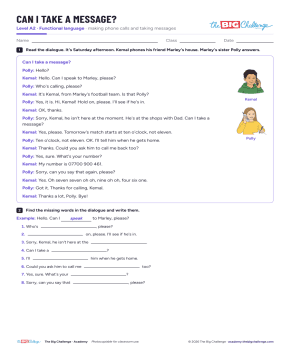
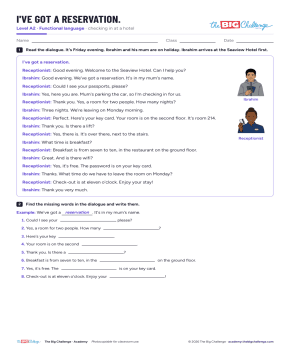
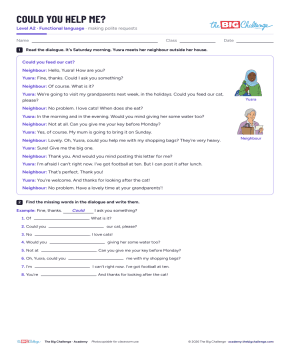
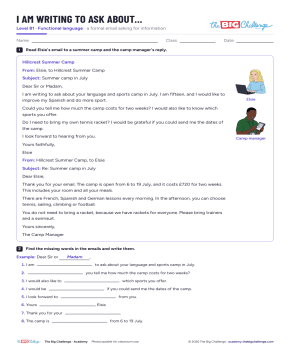
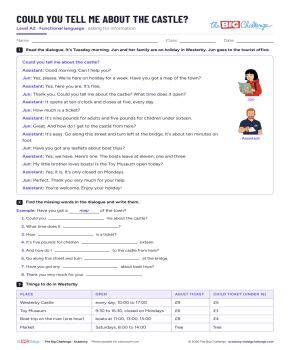
Asking for information at a tourist office: a map, opening times, ticket prices and the way, seen through Jun's questions about the castle, the boat trips and the museum on holiday in Westerby. Pupils find the missing words in the dialogue, read the useful phrases, match situations to phrases, choose the best reply, put a dialogue in order, complete another one and act out a role-play in pairs with a table of things to do; answer key included.
Documents to download (2)
- Colour version In your teacher account
- Black and white version In your teacher account
Teaching guide
Objective & content
This functional language sheet teaches pupils to ask for information politely (Could you tell me about the castle? Have you got a map? Have you got any leaflets about boat trips?), ask for opening times and prices (What time does it open? Is the museum open today? How much is a ticket?) and ask the way (How do I get to the castle? Go along this street and turn left.). Pupils read a dialogue in which Jun asks the assistant at a tourist office for help, find the missing words and read the useful phrases, given in a box. By the end, they can ask for a map, times, prices and the way, and thank someone for their help.
Pedagogical guide
Page 1 is the dialogue, with a picture of Jun and of the assistant: it's Tuesday morning, and Jun and her family are on holiday in Westerby for a week. The assistant gives her a free map and tells her that the castle opens at ten and closes at five every day, that a ticket is nine pounds for adults and five pounds for children under sixteen, and that the castle is about ten minutes on foot (along this street, left at the bridge). Jun also gets a leaflet about boat trips (boats at eleven, one and three) and learns that the Toy Museum is only closed on Mondays. Pupils find eight missing words in lines from the dialogue. Page 1 ends with a table, "Things to do in Westerby": the castle, the Toy Museum, a boat trip and the market, with opening times and adult and child prices. Page 2 has the useful phrases in a box, with the key words in bold and the answers after an arrow, five situations to match to a phrase (the price, the castle's opening time, the way, reading about boat trips later, a museum that might be closed on a Monday) and six questions with three replies each, where pupils tick the best one. Page 3 has a dialogue in which Darius asks about the Toy Museum on Thursday, to number from 1 to 8, and Esi's dialogue to complete with six words in a box. The last task is a role-play with the table on page 1: Student A wants to visit the Toy Museum on Wednesday with a sister of eight, then go on a boat trip in the afternoon; Student B is the assistant, with the way from the tourist office to each place on the card. Then they swap: B asks about the market and the castle. Every exercise opens with a worked example.
Suggested procedure
- (5 min) Say "You're on holiday in a new town. What can you ask at the tourist office?"; pupils suggest questions such as "Have you got a map?"
- (10 min) Read the dialogue aloud; pupils find the missing words.
- (5 min) Read the useful phrases in the box with the class; pupils find them in the dialogue.
- (10 min) Page 2: pupils match the situations to the phrases, then tick the best replies.
- (10 min) Page 3: pupils number the lines of Darius's dialogue, then complete Esi's dialogue.
- (10 min) Role-play: pupils read their cards and the table on page 1, then ask for and give information. Then they swap.
- (5 min) Check with the answer key on page 4.
Adaptations
[S] Pupils read the dialogue aloud in pairs, one as Jun and one as the assistant, before the tasks.
[A] Pupils add a place of their own town to the table and present it to the class.
Materials & prerequisites
One copy of pages 1 to 3 per pupil, and scissors for the role-play cards. Page 4 is the answer key and teacher notes: keep it. The role-play key gives the times and prices pupils find in the table (two child tickets for the museum are six pounds). Pupils need the present simple (It opens at ten), have got, can and the words for directions (left, right, along, straight on). Westerby is a made-up town. To take it further, pupils find a real tourist office website for a British town and write three questions they would ask.
Possible adaptations
- Lower levels: Offer segmented listening and additional visual aids.
- Advanced levels: Encourage an oral summary and a debate in English on the theme.
- Large groups: Organise group work with differentiated roles.
🔒 Restricted content
This resource requires a subscription to be viewed.
Unlock the resourceIncluded in the subscription