Tudor fashion
Interactive exercises to consolidate your students’ learning.
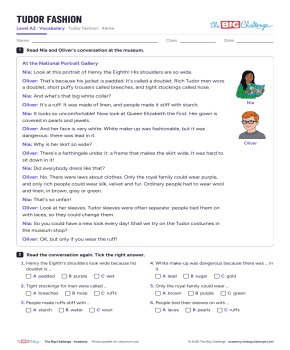
What the Tudors wore, through Nia and Oliver at the National Portrait Gallery in front of Henry VIII and Elizabeth I: doublets, ruffs, gowns, pearls and the laws about who could wear what. Pupils answer questions, match meanings, unscramble materials, make opposites with un-, complete sentences and label a Tudor couple; answer key included.
Documents to download (2)
- Colour version In your teacher account
- Black and white version In your teacher account
Teaching guide
Objective & content
This sheet on Tudor fashion starts from a conversation at the National Portrait Gallery in London: Nia and Oliver look at the portraits of Henry VIII and Elizabeth I and talk about what rich Tudors wore, from the padded doublet, breeches and hose to the ruff, the gown and the farthingale. They also learn that laws said who could wear what: only the royal family could wear purple, and ordinary people wore wool and linen. Pupils learn to describe what people wore in the past. They answer six multiple-choice questions, match eight words such as padded, stiff and ordinary with their meanings, put the letters of five materials in order, make four opposites with un- and complete eight sentences from a box of ten words. The sheet ends with a Tudor couple to label with eight words from a box of ten.
Pedagogical guide
The conversation carries the words of the topic, so pupils meet each one in context before working on it. The tasks go from recognising words to using them: meanings, materials, opposites, sentences, then a labelled picture. The materials (silk, linen, fur, velvet, pearls) are given as scrambled letters, with a worked example (wool). The word-form task asks for one kind of change only, adjectives with un-, and opens with a worked example (uncomfortable). In the last task, two words in the box have no place in the picture, so pupils must check every label. Every task tests words, never grammar. The facts are checked: ruffs were made of linen and stiffened with starch, and the white make-up of the time had lead in it, which made it dangerous.
Suggested procedure
- (5 min) Show a Tudor portrait and ask "What can you see? What is he wearing?"; write the words on the board.
- (10 min) Two pupils read the conversation aloud; the class answers the six questions.
- (10 min) Pupils match the eight words with their meanings, then put the letters of the five materials in order.
- (7 min) Read the worked example together; pupils make the four opposites with un-.
- (8 min) Pupils complete the sentences with the words in the box.
- (5 min) Pupils label the Tudor couple.
- (5 min) Check with the answer key on page 4.
Adaptations
[S] Show a Tudor portrait: pupils say what they can see before reading.
[A] Pupils describe a Tudor portrait in five sentences, with the words of the sheet. To take it further, the class makes a "Then and now" poster comparing Tudor clothes with today's fashion.
Materials & prerequisites
One copy of the three pupil pages per pupil, in colour or in black and white. Page 4 is the answer key: keep it. Pupils should know the past simple, there was and there were, had to, and could and couldn't.
Possible adaptations
- Lower levels: Offer segmented listening and additional visual aids.
- Advanced levels: Encourage an oral summary and a debate in English on the theme.
- Large groups: Organise group work with differentiated roles.
🔒 Restricted content
This resource requires a subscription to be viewed.
Unlock the resourceIncluded in the subscription