Too, enough and as ... as
Interactive exercises to consolidate your students’ learning.
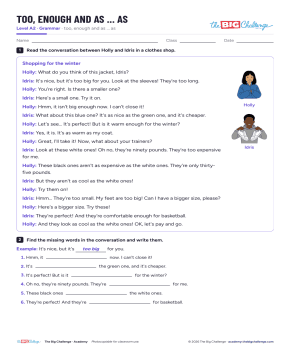
Too + adjective, (not) adjective + enough and (not) as ... as, seen through a conversation between two friends, Holly and Idris, shopping for winter clothes. Pupils find the missing words, read the rule, choose the right sentence, tick the right words, write too or enough with an adjective, compare things with as ... as and tick the true sentence about seven pictures; answer key included.
Documents to download (2)
- Colour version In your teacher account
- Black and white version In your teacher account
Teaching guide
Objective & content
This grammar sheet teaches too + adjective (too big), adjective + enough and not + adjective + enough (warm enough, isn't big enough), with for + a person or a thing and to + verb (too young to drive), and comparisons with as ... as and not as ... as (as warm as, aren't as expensive as). Pupils read a conversation between Holly and Idris, who are shopping for winter clothes, find the missing words and read the rule, given in a box. By the end, they can say what is wrong with something, say when it is fine, and compare two things that are or are not the same.
Pedagogical guide
Page 1 is the conversation, with a picture of Holly and of Idris: the first jacket is too big for Holly, the small one isn't big enough, and the blue one is as warm as Idris's coat; the white trainers are too expensive for Idris, and the black ones aren't as expensive, but they are too small until he tries a bigger size. Pupils find six missing groups of words in sentences from the conversation. Page 2 has the rule, given in a box in short lines with the key words in bold: what too, enough and not ... enough mean, too before the adjective and enough after it, for and to after them, and as ... as and not as ... as. Then pupils choose the right sentence in six pairs (the wrong one has enough before the adjective, too much + adjective, as ... than or as + a comparative); tick the right words in six sentences, where the first sentence decides (My brother is eighteen → old enough); and write too or enough with the adjective in brackets in six sentences. Page 3 has five pairs of facts (prices, weights, temperatures, speeds) to turn into sentences with as ... as or not as ... as. The last task has seven pictures (a baby, an elephant, a giraffe, a snowman, a mouse, a penguin and a cat) with two sentences each: pupils tick the true one. Every exercise opens with a worked example. The sheet works with adjectives only: there is no enough + noun and no too much or too many.
Suggested procedure
- (5 min) Hold up a coat or a bag and ask "Is it big enough? Is it too small?"; write the answers on the board.
- (10 min) Read the conversation aloud; pupils find the missing words.
- (5 min) Read the rule in the box with the class; pupils find a sentence in the conversation for each line.
- (15 min) Page 2: the right sentence, the right words, then too or enough with the adjective.
- (10 min) Page 3: sentences with as ... as, then the pictures.
- (5 min) Check with the answer key on pages 4 and 5.
Adaptations
[S] Pupils read the conversation aloud in pairs, one as Holly and one as Idris, before the tasks.
[A] Pupils write three sentences about their clothes or their room with too, enough and as ... as.
Materials & prerequisites
One copy of pages 1 to 3 per pupil. Pages 4 and 5 are the answer key and teacher notes: keep them. Short and full forms are both right (isn't or is not). Pupils need common adjectives (big, long, warm, expensive), comparatives (bigger, cheaper) and the words for clothes and shopping. To take it further, pupils play a shop role play: one pupil is the shop assistant, the other tries on clothes and says what is wrong with them.
Possible adaptations
- Lower levels: Offer segmented listening and additional visual aids.
- Advanced levels: Encourage an oral summary and a debate in English on the theme.
- Large groups: Organise group work with differentiated roles.
🔒 Restricted content
This resource requires a subscription to be viewed.
Unlock the resourceIncluded in the subscription