It doesn't work!
Interactive exercises to consolidate your students’ learning.
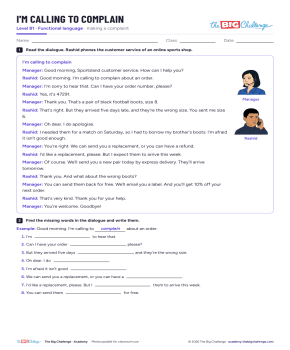
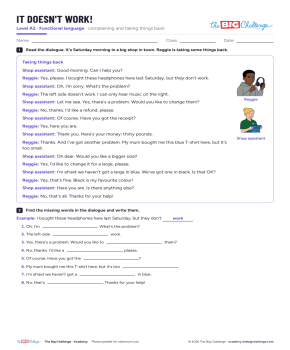
Taking something back to a shop: saying what the problem is, asking for a change or a refund and understanding the shop assistant, seen through Reggie, who takes back headphones that don't work and a T-shirt that is too small. Pupils find the missing words in the dialogue, read the useful phrases, match situations to phrases, choose the best reply, put a dialogue in order, complete another one and act out a role-play in pairs with the shop's rules; answer key included.
Documents to download (2)
- Colour version In your teacher account
- Black and white version In your teacher account
Teaching guide
Objective & content
This functional language sheet teaches pupils to take something back to a shop: they say the problem (It doesn't work. They don't work. It's too small. It's too big.), say what they want (I'd like to change it, please. I'd like a refund, please.) and understand the shop assistant (Can I help you? What's the problem? Have you got the receipt? I'm afraid we haven't got a large in blue.). Pupils read a dialogue in which Reggie takes two things back to a shop, find the missing words and read the useful phrases, given in a box. By the end, they can explain a problem with something they bought and ask for a change or a refund, politely.
Pedagogical guide
Page 1 is the dialogue, with a picture of Reggie and of the shop assistant: it's Saturday morning in a big shop in town. Reggie bought some headphones there last Saturday, but the left side doesn't work; he doesn't want new ones, he'd like a refund, he's got the receipt and he gets his thirty pounds back. Then he takes back a blue T-shirt from his mum that is too small: the shop hasn't got a large in blue, so he changes it for a black one. Pupils find eight missing words in lines from the dialogue. Page 2 has the useful phrases in a box, with the key words in bold, five situations to match to a phrase (trainers that are too small, a jumper that is too big, a coat in another colour, money back, a shop worker and a customer who wants a refund) and six lines with three replies each, where pupils tick the best one. Page 3 has a dialogue in which Tomasz takes back a video game that doesn't work, to number from 1 to 8, and a dialogue in which Ada takes back a dress that is too big, to complete with six words in a box. The last task is a role-play with an information gap: pupils cut out cards A and B. A is the customer with three things to take back (trainers that are too small, headphones that don't work, a jumper that is too big) and has receipts for two of them; B is the shop assistant, with the shop's rules (a refund only with the receipt) and the sizes in the shop. Then they swap. Every exercise opens with a worked example.
Suggested procedure
- (5 min) Show a pen that doesn't work and say "Excuse me, I bought this pen yesterday, but it doesn't work."; ask the class what you can say next.
- (10 min) Read the dialogue aloud; pupils find the missing words.
- (5 min) Read the useful phrases in the box with the class; pupils find them in the dialogue.
- (10 min) Page 2: pupils match the situations to the phrases, then tick the best replies.
- (10 min) Page 3: pupils number the lines of Tomasz's dialogue, then complete Ada's dialogue.
- (10 min) Role-play: A takes three things back, B answers from the shop's rules on the card; then pupils swap.
- (5 min) Check with the answer key on page 4.
Adaptations
[S] Pupils read the dialogue aloud in pairs, one as Reggie and one as the shop assistant, before the tasks.
[A] Pupils write a short dialogue about another thing to take back: a phone case, a football or a game.
Materials & prerequisites
One copy of pages 1 to 3 per pupil, and scissors for the role-play cards. Page 4 is the answer key and teacher notes: keep it. The role-play is free speaking, but the shop's rules decide what happens to each thing, and the key gives it: the trainers are changed for a size 6, the headphones get a refund of £25, and the jumper gets no refund (there is no receipt) but can be changed for a small or a medium. Pupils need the past simple (I bought), too + an adjective, the words for clothes and colours, sizes and prices in pounds. To take it further, set up a class "shop" with real objects and rules, and pupils take turns as customers and assistants.
Possible adaptations
- Lower levels: Offer segmented listening and additional visual aids.
- Advanced levels: Encourage an oral summary and a debate in English on the theme.
- Large groups: Organise group work with differentiated roles.
🔒 Restricted content
This resource requires a subscription to be viewed.
Unlock the resourceIncluded in the subscription