I'm calling to complain
Interactive exercises to consolidate your students’ learning.
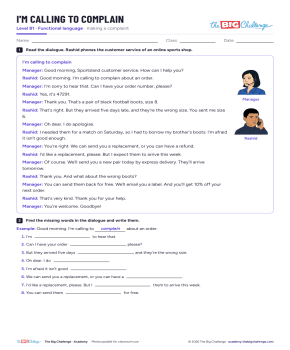
Making a complaint politely and firmly, saying what you want and answering a complaint, seen through Rashid's phone call to an online sports shop about football boots that arrived late and in the wrong size. Pupils find the missing words in the dialogue, read the useful phrases, match situations to phrases, choose the best reply, put a phone call in order, complete another one and act out a role-play in pairs with a customer card and a customer service card; answer key included.
Documents to download (2)
- Colour version In your teacher account
- Black and white version In your teacher account
Teaching guide
Objective & content
This functional language sheet teaches pupils to make a complaint politely and firmly (I'm calling to complain about my order. It arrived late. It's the wrong size. I'm afraid it isn't good enough.), say what they want (I'd like a refund, please. I'd like a replacement, please. I expect them to arrive this week.) and answer a complaint (I'm sorry to hear that. I do apologise. We'll send you a replacement.). Pupils read a phone call in which Rashid complains to an online sports shop, find the missing words and read the useful phrases, given in a box. By the end, they can make a complaint on the phone, say what they want and answer a customer politely.
Pedagogical guide
Page 1 is the phone call, with a picture of the manager and of Rashid: Rashid calls the customer service of Sportsland, an online sports shop, because his black football boots arrived five days late and in the wrong size (size 6, not size 8), so he had to borrow his brother's boots for Saturday's match. The manager apologises, sends a new pair today by express delivery, emails a label so he can send the wrong boots back for free and gives him 10% off his next order. Pupils find eight missing words in lines from the dialogue. Page 2 has the useful phrases in a box, with the key words in bold and the difference between a refund (your money back) and a replacement (a new one), five situations to match to a phrase (your money back, a new one, an answer that is not good enough, the customer service side, a T-shirt in the wrong size) and six lines with three replies each, where pupils tick the best one. Page 3 has a phone call in which Fern complains about a cancelled concert and asks for a refund of £70 for two tickets, to number from 1 to 8, and a call about broken headphones to complete with six words in a box. The last task is a role-play: pupils cut out cards A and B. A has two problems with online orders (a phone case that arrived broken, a hoodie that arrived ten days late in the wrong colour); B works in customer service and answers from the shop's rules in a table. Then they swap the cards. Every exercise opens with a worked example.
Suggested procedure
- (5 min) Ask "What can go wrong with an online order?"; pupils answer "It arrived late. It's the wrong size. It's broken."
- (10 min) Read the phone call aloud; pupils find the missing words.
- (5 min) Read the useful phrases in the box with the class; pupils find them in the dialogue.
- (10 min) Page 2: pupils match the situations to the phrases, then tick the best replies.
- (10 min) Page 3: pupils number the lines of Fern's phone call, then complete the call about the headphones.
- (10 min) Role-play: A complains, B answers from the shop's rules, then they swap the cards.
- (5 min) Check with the answer key on page 4.
Adaptations
[S] Pupils read the phone call aloud in pairs, one as Rashid and one as the manager, before the tasks.
[A] Pupils write a short complaint email about one of the problems on card A.
Materials & prerequisites
One copy of pages 1 to 3 per pupil, and scissors for the role-play cards. Page 4 is the answer key and teacher notes: keep it. The role-play is free speaking: B first offers a £5 voucher, and when A says it isn't good enough, B offers what the table on card B says. Pupils need the past simple (they arrived late, I had to borrow), will for a promise (We'll send you a new pair) and the words for clothes, shops and money. To take it further, pupils say what makes a complaint polite and what makes it firm, then act out a rude version and a polite one.
Possible adaptations
- Lower levels: Offer segmented listening and additional visual aids.
- Advanced levels: Encourage an oral summary and a debate in English on the theme.
- Large groups: Organise group work with differentiated roles.
🔒 Restricted content
This resource requires a subscription to be viewed.
Unlock the resourceIncluded in the subscription