


Human Body
Dostęp Early Bird
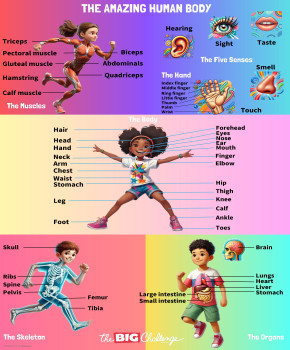
Explore the human body from head to toe with this rich, all-in-one infographic! Clear, colorful, and perfectly organized, this resource is an ideal visual dictionary for introducing or revising a wide range of vocabulary. From the simplest body parts to the more complex muscles, bones, and organs, this poster is a versatile resource that can be adapted for several levels. It is the perfect tool for making the learning of body lexicon visual and engaging.
Plakat dla Twojej klasy
Gotowy plakat do użycia w klasie. Możesz go pobrać w wysokiej rozdzielczości i wydrukować.
Oferta specjalna Early Bird. Zarejestruj uczniów do konkursu już teraz, odblokuj dostęp do materiałów i ciesz się ekskluzywnymi korzyściami!
Przewodnik pedagogiczny
Resource Objective & Content
The objective is to introduce, consolidate and expand vocabulary related to the human body, including external parts, muscles, bones, organs and the five senses.
The document is a comprehensive infographic titled "THE AMAZING HUMAN BODY". It presents several detailed diagrams:
- "The Body" : shows external parts like the head (head) , arm (arm) , leg (leg) and foot (foot).
- "The Muscles" : identifies key muscles such as the biceps (Biceps) , abdominals (Abdominals) and quadriceps (Quadriceps).
- "The Skeleton" : labels major bones like the skull (Skull) , spine (Spine) and femur (Femur).
- "The Organs" : presents the brain (Brain) , heart (Heart) , lungs (Lungs) and stomach (Stomach).
- "The Five Senses" : illustrates sight (Sight) , hearing (Hearing) , smell (Smell) , taste (Taste) and touch (Touch).
- "The Hand" : details the parts of the hand, including the thumb (Thumb) and fingers (Index finger, Middle finger...).
Suggested Activity Flow
Before the activity (~5 min): BODY BRAINSTORM
-
Give students one minute to write down all the English words they know for body parts on a sheet of paper. Then share the answers on the board.
During the activity (~10-15 min): SIMON SAYS... TOUCH YOUR KNEE!
-
Project the infographic or distribute copies. Go through one section at a time (e.g., "The Body"). Say each word, have the class repeat it, and ask students to point to the corresponding part on their own body.
-
Turn the activity into a "Simon Says" game to make learning more dynamic ("Simon says touch your knee.", "Touch your elbow.").
After the activity (~10 min): DESCRIBE A CHARACTER
-
Show an image of a famous cartoon character or superhero.
-
Ask students to describe them using vocabulary from the poster. For example: "He has big biceps and strong legs.", "She has long hair and blue eyes.".
Adaptations
-
To simplify (A2): Focus only on one or two sections, such as "The Body" and "The Five Senses". Use the "Simon Says" game as the main activity to playfully anchor vocabulary.
-
To deepen (B1): In pairs, one student describes a health problem ("I have a pain in my stomach.", "I hurt my knee and my ankle.") and their classmate gives them advice. They can use the "Muscles", "Skeleton" and "Organs" sections for more specific vocabulary.