


Irregular Verbs
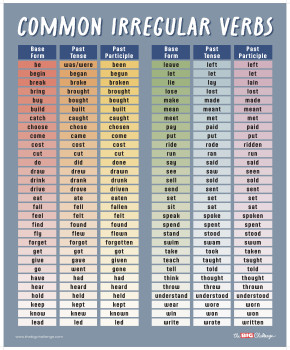
Irregular verbs are an essential (and often dreaded!) part of learning English. This clear and concise reference sheet is the indispensable tool for your students! It gathers the most frequent verbs in a format that is easy to consult and memorize. No more hesitation about the past tense (preterite) of "go" or the past participle of "eat." It is the ideal resource for class, homework revision, or for fun memorization activities.
Plakat dla Twojej klasy
Gotowy plakat do użycia w klasie. Możesz go pobrać w wysokiej rozdzielczości i wydrukować.
Te materiały są dostępne bezpłatnie. Wystarczy utworzyć konto lub zalogować się, aby uzyskać natychmiastowy dostęp.
Przewodnik pedagogiczny
Resource Objective & Content
The objective is to help students memorize the past tense forms ("Past Tense") and past participle forms ("Past Participle") of the most common irregular verbs, and to use them correctly in sentences.
The document is a reference list titled "COMMON IRREGULAR VERBS". It presents about sixty high-frequency irregular verbs, organized in a three-column table: "Base Form" (infinitive), "Past Tense" (preterite), and "Past Participle" (past participle). The list includes fundamental verbs such as be/was-were/been, go/went/gone, eat/ate/eaten, and take/took/taken.
Suggested Activity Flow
Before the activity (~5 min): REGULAR OR IRREGULAR?
-
Write a regular verb on the board (e.g., play) and ask for its past form (played). Then write an irregular verb (e.g., go) and ask for its past form (went). Ask students to explain the difference to introduce the concept.
During the activity (~10-15 min): VERB BINGO!
-
Create simple bingo grids with the base form of 9 to 12 verbs from the list.
-
The teacher calls out the past tense or past participle form of a verb (e.g., "spoke"). Students who have the corresponding base form ("speak") on their grid can check it off. The first to get a line wins.
After the activity (~10 min): TELL ME A STORY
-
Give students a short list of 3-4 irregular verbs from the sheet (e.g., go, see, buy, eat).
-
In pairs, they must create a very short story (2-3 sentences) in the past tense using these verbs. For example: "Yesterday, I went to the shop. I saw a cake. I bought it and I ate it.".
Adaptations
-
To simplify (A2): Focus only on the first two columns (Base Form and Past Tense). Work with a reduced selection of 10-15 of the most common verbs (be, go, do, have, see, eat, etc.).
-
To deepen (B1): Introduce the Present Perfect and explain the use of the third column (Past Participle). Ask students to write sentences in the Present Perfect using verbs from the list (e.g., "I have never eaten snails.").