


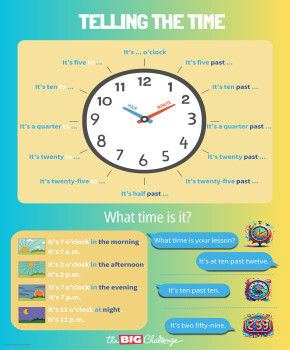
Telling the Time
Dostęp Early Bird
Does telling time in English seem complicated to you? Not anymore! This simple and brilliant infographic makes learning how to tell time easy and intuitive. By visually dividing the clock into two halves, "past" and "to," it offers students a clear mental model so they'll never make a mistake again. It's the perfect tool for mastering an essential daily skill in a fun and memorable way.
Plakat dla Twojej klasy
Gotowy plakat do użycia w klasie. Możesz go pobrać w wysokiej rozdzielczości i wydrukować.
Oferta specjalna Early Bird. Zarejestruj uczniów do konkursu już teraz, odblokuj dostęp do materiałów i ciesz się ekskluzywnymi korzyściami!
Przewodnik pedagogiczny
Resource Objective & Content
The objective is to learn and practice asking and telling the time in English, using the structure with "past" and "to".
The document is a visual guide titled "TELLING THE TIME". Its main element is a large clock face that visually divides the minutes. The right side is dedicated to minutes "after" the hour (e.g.: It's five past ... , It's a quarter past ... ), and the left side is for minutes "before" the next hour (e.g.: It's twenty to ... , It's a quarter to ... ). It clearly indicates the expressions It's ... o'clock (for exact hours) and It's half past ... (for half past). The infographic also includes examples of questions ("What time is it?" ) and answers, including the use of a.m. and p.m. for different times of the day.
Suggested Procedure
Before the Activity (~5 min): THE CLOCK ON THE BOARD
-
Draw a simple clock on the board. Review numbers from 1 to 12. Show the hour and minute hands and ask students to name them in English (hour hand, minute hand).
During the Activity (~10-15 min): "PAST" OR "TO"?
-
Project the infographic. First, focus on the right side ("past"). Use a real or drawn clock to move the minute hand to 5, 10, 15, 20, 25, and 30, repeating the corresponding phrase in chorus ("It's five past!", "It's ten past!"...).
-
Do the same for the left side with "to".
After the Activity (~10 min): THE HUMAN CLOCK
-
Draw a large clock circle on the floor with chalk or tape. Two students play the role of the hands.
-
The teacher announces a time ("It's a quarter past three!"). The two students must position themselves correctly. The rest of the class validates if the time is correct.
Adaptations
-
To simplify: Focus only on "o'clock" and "half past" during the first lesson. Introduce the "past" part in a second lesson, and the "to" part in a third. Use individual cardboard clocks that students can manipulate themselves.
-
To elaborate: Ask students to write their daily schedule (e.g.: "I wake up at...", "I have lunch at...") using the complete expressions from the sheet to tell the time.