


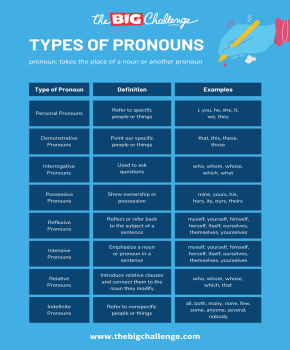
Types of Pronouns
Demystify pronouns with this clear, complete, and effective cheat sheet! This grammar sheet is the ultimate tool to help your students understand the different categories of pronouns and their functions. Presented in an easy-to-read table, it allows for easy visualization and memorization of personal, possessive, relative pronouns, and many others. It is the perfect reference resource for improving the accuracy and fluency of speech, both orally and in writing.
Plakat dla Twojej klasy
Gotowy plakat do użycia w klasie. Możesz go pobrać w wysokiej rozdzielczości i wydrukować.
Te materiały są dostępne bezpłatnie. Wystarczy utworzyć konto lub zalogować się, aby uzyskać natychmiastowy dostęp.
Przewodnik pedagogiczny
Resource Objective & Content
The objective is to help students identify, understand the function, and correctly use the eight main types of pronouns in English.
The document is a grammar reference sheet titled "TYPES OF PRONOUNS". It begins with the definition of a pronoun: a word that replaces a noun or another pronoun. The core of the resource is a table detailing eight types of pronouns. For each type — Personal, Demonstrative, Interrogative, Possessive, Reflexive, Intensive, Relative, and Indefinite — the table provides a concise definition and a list of examples (e.g., for possessive pronouns: "Show ownership or possession", with examples "mine, yours, his, hers...").
Suggested Activity Flow
Before the activity (~5 min): REPLACE THE NOUN!
-
Write a short story on the board with a repeating noun (e.g., "John is a student. John likes football. John's bag is blue."). Ask students how to improve the text, which will lead them to replace "John" and "John's" with pronouns (he, his).
During the activity (~15 min): THE PRONOUN HUNT
-
Project the reference sheet or distribute copies. Quickly review each category.
-
Give students a short authentic text (excerpt from a news article, paragraph from a short story). In pairs, they should find as many pronouns as possible and classify them by category using the sheet (e.g., highlight personal pronouns in yellow, demonstrative pronouns in green, etc.).
After the activity (~10 min): FILL-IN-THE-BLANKS
-
Prepare an exercise sheet with sentences where the correct pronoun is missing. Students must use the reference sheet to choose the right type and form of pronoun.
-
Examples: "The book on the table is ______. (mine/my/I)", or "The student ______ sits next to me is new. (who/which/what)".
Adaptations
-
To simplify: Focus on only 2 or 3 types of pronouns per lesson (e.g., Personal, Demonstrative, and Possessive). Use very simple sentences for the fill-in-the-blanks activity.
-
To deepen understanding: Focus on the difference between similar categories, such as reflexive and intensive pronouns ("I did it myself" vs. "I, myself, think it's a good idea") or interrogative and relative pronouns ("Who is that?" vs. "The man who is here...").