I can sing!
Interactive exercises to consolidate your students’ learning.
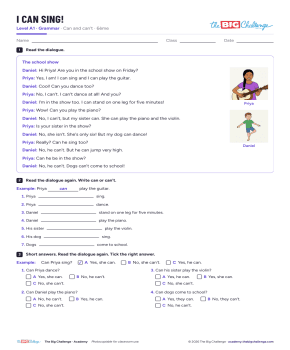
What people can and can't do, seen through Priya and Daniel's chat about the school show. Pupils complete the rule, choose the right sentences and short answers, write about animals and about themselves, make questions, then walk round the class to find someone who can; answer key included.
Documents to download (2)
- Colour version In your teacher account
- Black and white version In your teacher account
Teaching guide
Objective & content
This grammar sheet teaches can and can't to talk about what people can and can't do: one form for every person, no -s and no to before the verb, questions with Can you ...? and the short answers Yes, I can. / No, I can't. Pupils read Priya and Daniel's dialogue about the school show, then complete the rule themselves and use it. By the end, they can say what they and others can and can't do, and ask a classmate about it.
Pedagogical guide
Page 1 is the dialogue: Priya can sing and play the guitar but can't dance; Daniel can stand on one leg for five minutes, and his dog can dance but can't come to school. Pupils write can or can't in seven sentences about it, then tick four short answers. Page 2: pupils complete the rule (five gaps, five words in the box, each used once), choose the right sentence out of three in seven items (She can swim., not She cans swim. or She can swims.), then write eight animal sentences from a tick or a cross (Penguins can't fly.). Page 3 has six questions to write from prompts (you / ride a bike), four sentences about the pupils themselves, then "Find someone who": pupils walk round the class asking "Can you ...?" and write a different classmate's name on each of the twelve lines. Activities 2 to 7 each open with a worked example; the last two are open and have no key.
Suggested procedure
- (5 min) Tell the class two things you can do and one thing you can't; ask a few pupils "Can you sing?"
- (8 min) Pupils read the dialogue in pairs, then write can or can't and tick the short answers.
- (5 min) Pupils complete the rule alone, then check it with the class.
- (10 min) Page 2: pupils choose the right sentences, then write the animal sentences.
- (7 min) Page 3: pupils write the questions, then four sentences about themselves.
- (10 min) "Find someone who": pupils walk round the class and ask their questions.
- (5 min) Check with the answer key on page 4.
Adaptations
[S] Before the game, the class mimes the abilities in the grid while you read them aloud.
[A] Pupils write four more sentences, this time about someone in their family or a pet ("My brother can cook.").
Materials & prerequisites
One copy of pages 1 to 3 per pupil; space to move round the classroom for the game. Page 4 is the answer key and teacher notes: keep it. Cannot is also right for can't. Pupils need simple action verbs (swim, sing, dance, jump) and a few animal names. To take it further, pupils report to the class what they found ("Lina can stand on one leg for one minute!").
Possible adaptations
- Lower levels: Offer segmented listening and additional visual aids.
- Advanced levels: Encourage an oral summary and a debate in English on the theme.
- Large groups: Organise group work with differentiated roles.
🔒 Restricted content
This resource requires a subscription to be viewed.
Unlock the resourceIncluded in the subscription