Music and the stage
Interactive exercises to consolidate your students’ learning.
Instruments, singers, dancers and the stage, seen through a video call between Carmen, who has a ticket for a Broadway musical, and Nathan, who tells her about Inuit throat singing and a First Nations powwow in Canada. Pupils name pictures, unscramble instruments, answer questions on the text, complete sentences and solve a word search from clues; answer key included.
Documents to download (2)
- Colour version In your teacher account
- Black and white version In your teacher account
Teaching guide
Objective & content
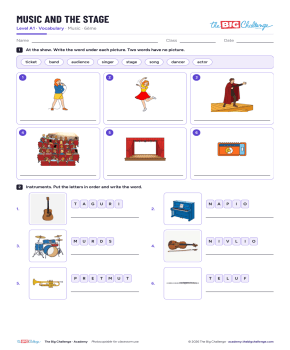
This sheet on music and the stage teaches instruments such as guitar, piano, drums, violin, trumpet and flute, the people of a show, such as singer, dancer, actor, audience and band, and words like stage, ticket, musical and clap. Pupils name pictures, read a video call between Carmen in New York and Nathan in Canada, then use the words. By the end, they can name musical instruments and the people and things of a show, and say what they can play ("I can play the piano").
Pedagogical guide
Page 1 names six people and things of a show from pictures; the word box holds two extra words, so pupils must choose. Pupils then put the letters of six instruments in order, each with its picture (TAGURI, NAPIO). Page 2 is the video call: Carmen has a ticket for a musical on Broadway, a famous street in New York, and her big sister, a singer, wants a Grammy one day. Nathan tells her about two Inuit women who sing at his school: they sing face to face and make sounds in their throats, and the first singer to laugh loses. He also tells her about the powwow in his town every summer, a First Nations celebration where a group of singers play a big drum together and everybody can come and watch. Eight multiple-choice questions follow. Page 3 has eight sentences to complete from a word box with two extra words, then a word search: pupils read twenty clues, write the words and find them in the grid, and the letters left over spell a message. Every task tests words only. The video call uses the present simple, can and there is / there are: there is no past tense on the sheet.
Suggested procedure
- (5 min) Ask pupils which instruments they know; write the English words on the board.
- (8 min) Page 1: pupils write the words under the pictures, then put the letters of the instruments in order.
- (10 min) Read the video call aloud with two voices; pupils answer the questions.
- (7 min) Page 3: pupils complete the sentences with the words in the box.
- (12 min) Pupils read the clues, write the words and find them in the word search.
- (5 min) Check with the answer key on pages 4 and 5.
Adaptations
[S] Play a few seconds of a song from a musical, a song with a guitar and a piece of Inuit throat singing; pupils say what they hear.
[A] Pupils say what they can and can't play or sing ("I can play the drums", "I can't play the violin").
Materials & prerequisites
One copy of pages 1 to 3 per pupil; a few short sound clips help (a musical, a guitar, Inuit throat singing). Pages 4 and 5 are the answer key and teacher notes: keep them. Pupils need the present simple, can and there is / there are. To take it further, the class makes a poster for a class concert, with the show, the band, the date and the ticket price.
Possible adaptations
- Lower levels: Offer segmented listening and additional visual aids.
- Advanced levels: Encourage an oral summary and a debate in English on the theme.
- Large groups: Organise group work with differentiated roles.
🔒 Restricted content
This resource requires a subscription to be viewed.
Unlock the resourceIncluded in the subscription