Not talking
Interactive exercises to consolidate your students’ learning.
Each other against the -self words (myself, yourself, himself, ourselves, themselves...), by myself for alone or without help, and the verbs that take no -self word in English (feel, concentrate, remember, get up). Pupils read a dialogue between three friends before a group presentation, find the missing words, read the rule, tick the sentence that means the same and the right word, write a -self word, each other or nothing, and circle the right words in a message, then write about a good friend; answer key included.
Documents to download (2)
- Colour version In your teacher account
- Black and white version In your teacher account
Teaching guide
Objective & content
This grammar sheet teaches each other against the -self words: myself, yourself, himself, herself, itself, ourselves, yourselves and themselves when the same person does it and gets it (He blames himself), each other when A does it to B and B does it to A (They blame each other), by myself for alone or without help, and the verbs that take no -self word in English (feel, concentrate, remember, get up). Pupils read a dialogue between Soraya, Gethin and Kwabena before a group presentation, find the missing words and read the rule, given in a chart. By the end, they can choose between a -self word, each other and nothing, and they stop writing We know us and I feel myself tired.
Pedagogical guide
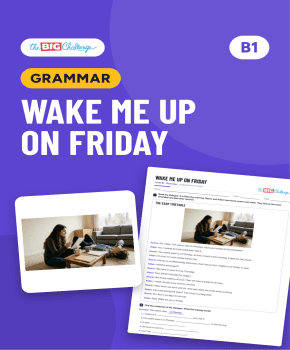
The sheet asks two questions before each choice: who does it, and who gets it? Many pupils' own language says both meanings with one word, so the meaning comes first, then the form. Page 1 is the dialogue, with a photo of the scene and five sentences to find, all copied from the text. Page 2 opens with the rule chart. Pupils then tick the sentence that means the same in five items, which puts themselves and each other side by side, and tick the right word in seven items. Page 3 opens with a chart of five usual mistakes (a -self word after feel, meet and remember, We know us, yourself for two people). Pupils then write a -self word, each other or X when the sentence needs nothing in seven items, circle the right words in Soraya's message to her sister, and write four sentences about a good friend, with a starter. Every exercise opens with a worked example. The sheet uses the present simple and continuous, the past simple, the present perfect with since and for, will and can / could, with no conditional, no passive and no past perfect. It leaves out the emphatic use (I did it myself), each other's and one another beyond a single line.
Suggested procedure
- (5 min) Write They looked at themselves and They looked at each other on the board. Two pupils mime each one; the class says which is which.
- (10 min) Read the dialogue aloud in threes; pupils find the five missing words (exercise 2).
- (5 min) Read the rule chart on page 2 with the class. For each row, ask: who does it, and who gets it?
- (15 min) Page 2: exercises 4 and 5.
- (10 min) Page 3: the chart of mistakes, then exercises 7 and 8.
- (5 min) Check with the answer key on page 4. Pupils can write exercise 9 at home.
Adaptations
[S] Pupils read the dialogue aloud in threes before they look for the missing words.
[A] In pairs, pupils mime an action (look at yourselves, look at each other, talk to each other...) and the class says it.
Materials & prerequisites
One copy of pages 1 to 3 per pupil, in colour or in black and white. Page 4 is the answer key and teacher notes: keep it. Pupils need the object pronouns (me, him, them), the present simple and past simple of common verbs, and a few words for a group project (presentation, slides, blame).
Curriculum alignment
French lycée programme (2025): the grammar lists name "reflexive and reciprocal verbs", "reflexive pronouns with phrasal verbs" (B1+) and, among the B2 structures, "reciprocal pronouns (each other, one another)". The sheet covers the -self words, each other, by myself and the verbs that take neither.
Possible adaptations
- Lower levels: Offer segmented listening and additional visual aids.
- Advanced levels: Encourage an oral summary and a debate in English on the theme.
- Large groups: Organise group work with differentiated roles.
🔒 Restricted content
This resource requires a subscription to be viewed.
Unlock the resourceIncluded in the subscription