You didn't forget, did you?
Interactive exercises to consolidate your students’ learning.
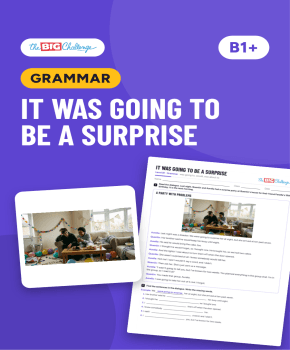
Question tags and short answers: a yes sentence takes a no tag, a no sentence takes a yes tag, the helping verb is repeated (or do, does, did when there is none), and the tag ends with a pronoun, with aren't I?, shall we? and never or nobody as special cases. Pupils read a dialogue between two friends, one of whom tests whether the other remembers her birthday, find the missing words, read the rule, tick the tag and the short answer, add tags, answer from a table and question a partner; answer key included.
Documents to download (2)
- Colour version In your teacher account
- Black and white version In your teacher account
Teaching guide
Objective & content
This grammar sheet teaches question tags and short answers: a yes sentence takes a no tag (I can see it now, can't I?), a no sentence takes a yes tag (You didn't forget, did you?), the helping verb is repeated (or do, does, did when there is none), and the tag ends with a pronoun, never a name. It also covers aren't I?, shall we?, never and nobody (which count as no) and short answers (Yes, I did. No, I didn't.). Pupils read a dialogue between Kasper and Halima, who tests whether he remembers her birthday, find the missing words and read the rule, set out in a chart. By the end, they build the tag from the verb in the sentence, and they stop writing You like tea, isn't it?.
Pedagogical guide
The sheet works on one rule: look at the helping verb, then decide whether the sentence is yes or no. Page 1 is the dialogue, with a photo of the scene and six tags to find. Page 2 opens with the rule chart (six rows: the sentence, the tag, an example, and a line on the pronoun), then pupils choose the right tag (exercise 4: six items, three options each) and the right short answer (exercise 5: five items, where the words after the gap show whether the answer is yes or no). Page 3 opens with the chart of three usual mistakes (You like tea, isn't it?, Yes, I like, Yes, I didn't). Pupils then add five tags, read a table of six facts about Kasper, write Halima's tag and Kasper's true short answer for five lines, and write three sentences with a tag about a partner, then ask them. Every exercise opens with a worked example. The sheet uses the present simple, the past simple, the present perfect, can and will.
Suggested procedure
- (5 min) Say You like pizza, don't you? to a pupil and have them answer with a short answer. Repeat with a no sentence (You don't like homework, do you?). Write the two sentences on the board and keep them for step 3.
- (10 min) Read the dialogue aloud in two voices; pupils find the six missing tags (exercise 2).
- (5 min) Read the rule chart with the class. Pupils say, for each board sentence, which helping verb the tag repeats and whether it is yes or no.
- (15 min) Page 2: exercises 4 and 5.
- (10 min) Page 3: the chart of mistakes, then exercises 7 to 9.
- (5 min) Check with the answer key on page 4. Pupils can write exercise 10 at home and ask their partner next lesson.
Adaptations
[S] Pupils read the dialogue aloud in pairs before they look for the missing tags.
[A] In pairs, pupils write six tag questions for the teacher and guess the short answers before asking.
Materials & prerequisites
One copy of pages 1 to 3 per pupil, in colour or in black and white. Page 4 is the answer key and teacher notes: keep it. Pupils need the present simple, the past simple, the present perfect, can and will, and a few words for birthdays and everyday facts (driving test, afraid of dogs, drums).
Curriculum alignment
French lycée programme (2025), grammar list at B1+ (verb patterns): "short answers and tags". The sheet covers both, with the special cases aren't I?, shall we? and never / nobody.
Possible adaptations
- Lower levels: Offer segmented listening and additional visual aids.
- Advanced levels: Encourage an oral summary and a debate in English on the theme.
- Large groups: Organise group work with differentiated roles.
🔒 Restricted content
This resource requires a subscription to be viewed.
Unlock the resourceIncluded in the subscription