It was going to be a surprise
Interactive exercises to consolidate your students’ learning.
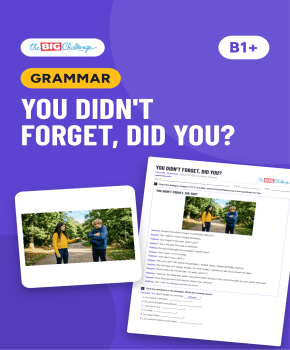
The future seen from a moment in the past: was / were going to for a plan that changed (We were going to surprise her at eight), would after thought, knew and said (I thought he would forget), the negatives wasn't going to and wouldn't, and was about to for just before. Pupils read a dialogue between two friends the morning after a surprise party that went wrong, find the missing words, read the rule, decide what really happened, tick, write and circle the right forms, then write about a day when nothing went as planned; answer key included.
Documents to download (2)
- Colour version In your teacher account
- Black and white version In your teacher account
Teaching guide
Objective & content
This grammar sheet teaches how to talk about the future as it looked at a moment in the past: was / were going to + verb for a plan that then changed or failed (We were going to surprise her at eight), thought / knew / said + would + verb (I thought he would forget), the negatives wasn't / weren't going to and wouldn't, and was / were about to + verb for the moment just before (I was about to turn them off when the door opened). Pupils read a dialogue between Quentin and Aurelia, who talk the morning after a surprise party for their friend Fenella's 18th birthday, where nothing went as planned, find the missing words and read the rule, given in a box. By the end, they can say what was still ahead at a moment in the past, and they stop writing I thought she will arrive.
Pedagogical guide
Say it plainly: all these forms look back from a moment in the past. Was going to gives the plan, not what happened (I was going to call you means I did not call), would is will moved back after a past verb, and was about to means just before. Many pupils keep will after a past verb because their own language does. Page 1 is the dialogue, with one photo of the scene and six missing words to find. On page 2, pupils read the rule box, tick what really happened in five sentences, then tick the right form of three in seven sentences. Page 3 opens with a box on three usual mistakes and a line on was going to; pupils then turn will into would in four sentences, write four failed plans with was / were going to, circle the right words in Fenella's message to her gran and write three sentences about a day when nothing went as planned. Exercises 2, 4, 5, 7 and 8 open with a worked example, and the writing task with a sentence starter. The sheet uses the past simple, the past continuous and the present simple, with one present perfect with for (I've known for two weeks) and will only inside quoted words. It leaves out would for past habits, would have + past participle, was to, was supposed to and the other changes of reported speech (tenses, pronouns, words of place and time).
Suggested procedure
- (5 min) Write I was going to ... but ... on the board and finish it with a true example of your own (I was going to bring my book, but I forgot it). Ask pupils whether you brought the book.
- (10 min) Read the dialogue aloud, in pairs or with two pupils; pupils find the six missing words (exercise 2).
- (5 min) Read the rule box with the class. For each line, ask: from which moment in the past are we looking at the future?
- (15 min) Page 2: exercises 4 and 5.
- (10 min) Page 3: the box on usual mistakes, then exercises 7, 8 and 9.
- (5 min) Check with the answer key on page 4. Pupils can write exercise 10 at home and read it aloud next lesson.
Adaptations
[S] Pupils read the dialogue aloud in pairs; for each was going to, they say what happened instead.
[A] In pairs, pupils write the message Quentin sends Fenella's brother, with two things he said he would do.
Materials & prerequisites
One copy of pages 1 to 3 per pupil, in colour or in black and white. Page 4 is the answer key and teacher notes: keep it. Pupils need the past simple, will and going to for the future, and a few party words (surprise, cake, group chat, keep somebody busy).
Curriculum alignment
French lycée programme (2025), English: "past habit and future in the past" is on its list of B1+ grammar items, and "reported speech with say, tell, ask, answer" is on its B1 list. The sheet covers the future in the past with was / were going to, would and was / were about to; would for past habits is not covered here.
Possible adaptations
- Lower levels: Offer segmented listening and additional visual aids.
- Advanced levels: Encourage an oral summary and a debate in English on the theme.
- Large groups: Organise group work with differentiated roles.
🔒 Restricted content
This resource requires a subscription to be viewed.
Unlock the resourceIncluded in the subscription