Reported speech
Interactive exercises to consolidate your students’ learning.
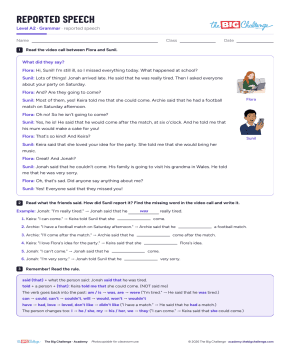
Reported speech with said (that) and told + a person, with the verb back in the past (was, could, would, had) and the person changed, seen through a video call where Sunil tells Flora what their friends said about her party. Pupils find the reported verbs, read the rule, choose said or told, report sentences, find who said what about a class picnic and repair a gossip chain; answer key included.
Documents to download (2)
- Colour version In your teacher account
- Black and white version In your teacher account
Teaching guide
Objective & content
This grammar sheet teaches reported speech with said (that) and told + a person + (that): the verb goes back into the past (am and is → was, are → were, can → could, will → would, have → had, don't like → didn't like) and the person changes (I → he or she, my → his or her, we → they). Pupils read a video call: Flora is ill at home, and Sunil tells her what their friends said at school about her party. They find how Sunil reported each sentence and read the rule, given in a box. By the end, they can report what someone said.
Pedagogical guide
Page 1 is the video call, with a picture of Flora and of Sunil: Jonah said that he was really tired and that he couldn't come to the party, Keira told Sunil that she could come and would bring her music, and Archie said that he would come after his football match. Pupils read six sentences in the friends' own words and find the verb Sunil used to report each one. Then they read the rule, given in a box in short lines with the key words in bold: said (that), told + a person (not said me), the verbs that go back into the past and the person that changes. Page 2 has eight sentences where pupils tick said or told (the word after the gap decides) or the right past verb; seven sentences to report with the verb in the past; six sentences where the person changes (he, she, they, his, her, their, me); and four whole sentences to report, changing the verb and the person. Page 3 is the final task, "Who said it?": Keira, Archie and Jonah plan a class picnic, and that evening Sunil tells Flora what "someone" said. Pupils find who said each of seven sentences (he or she, would or wouldn't, could or couldn't decide). Then comes a gossip chain: five messages changed at school the next day, and pupils write what the friend really said. Last, pupils write three sentences with said or told about what their friends or family said yesterday. Every exercise opens with a worked example, except the last task. The sheet teaches reported statements only: there are no reported questions or orders.
Suggested procedure
- (5 min) Say "I'm tired" to the class, then ask "What did I say?" and write You said that you were tired. on the board.
- (10 min) Read the video call aloud; pupils find the reported verbs.
- (5 min) Read the rule in the box with the class; pupils find said and told in the video call.
- (15 min) Page 2: said or told and the right verb, the verb in the past, the person, then whole sentences.
- (15 min) Page 3: "Who said it?", the gossip chain, then three sentences of their own.
- (5 min) Check with the answer key on pages 4 and 5.
Adaptations
[S] Pupils read the video call aloud in pairs, one as Flora and one as Sunil, before the tasks.
[A] In pairs, pupils say a sentence about themselves and their partner reports it to the class (Tom said that he had a cat.).
Materials & prerequisites
One copy of pages 1 to 3 per pupil. Pages 4 and 5 are the answer key and teacher notes: keep them. Contracted and full forms are both right (couldn't or could not), and that can be left out. Pupils need the present simple and the past simple, can and will, and the possessive adjectives (my, his, her, their). To take it further, the class plays a gossip chain: one sentence is whispered from pupil to pupil, and the last pupil reports it aloud.
Possible adaptations
- Lower levels: Offer segmented listening and additional visual aids.
- Advanced levels: Encourage an oral summary and a debate in English on the theme.
- Large groups: Organise group work with differentiated roles.
🔒 Restricted content
This resource requires a subscription to be viewed.
Unlock the resourceIncluded in the subscription