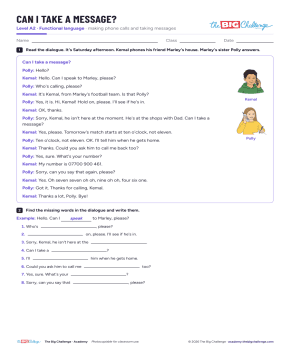
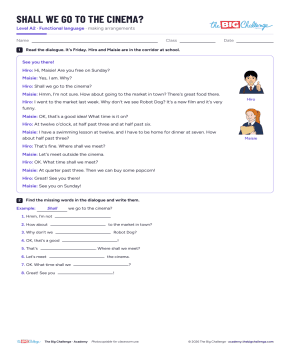
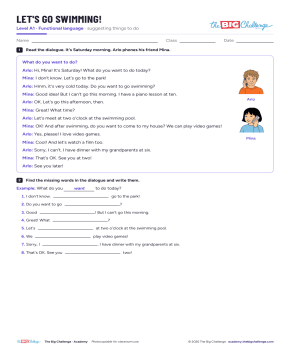
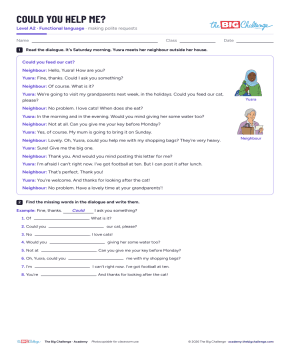
Would you like to come?
Interactive exercises to consolidate your students’ learning.
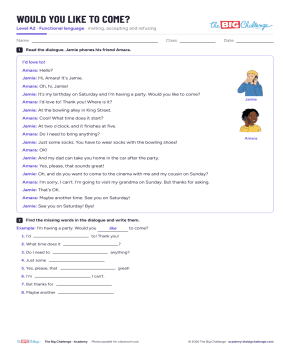
Inviting a friend, saying yes, saying no politely with a reason and asking where, when and what to bring, seen through Jamie's phone call to invite Amara to his birthday party. Pupils find the missing words in the dialogue, read the useful phrases, match situations to phrases, choose the best reply, put a dialogue in order, complete another one and act out a role-play in pairs with an invitation card and a weekend diary; answer key included.
Documents to download (2)
- Colour version In your teacher account
- Black and white version In your teacher account
Teaching guide
Objective & content
This functional language sheet teaches pupils to invite a friend (Would you like to come to my party? Do you want to come to the cinema?), say yes (I'd love to! Yes, please, that sounds great!), say no politely and say why (I'm sorry, I can't. I'm going to visit my grandma. Thanks for asking. Maybe another time.) and ask about the plan (Where is it? What time does it start? Do I need to bring anything?). Pupils read a phone call in which Jamie invites Amara to his birthday party, find the missing words and read the useful phrases, given in a box. By the end, they can invite a friend, and say yes or a polite no with a reason.
Pedagogical guide
Page 1 is the dialogue, with a picture of Jamie and of Amara: Jamie invites Amara to his birthday party on Saturday at the bowling alley in King Street, from two o'clock to five. Amara says yes, asks where it is, what time it starts and what to bring (socks, to wear with the bowling shoes). Then Jamie invites her to the cinema on Sunday, and she says no: she is going to visit her grandma. Pupils find eight missing words in lines from the dialogue. Page 2 has the useful phrases in a box, with the key words in bold, five situations to match to a phrase (saying yes, saying no with a reason, asking the time, asking what to bring, suggesting another day) and six lines with three replies each, where pupils tick the best one. Page 3 has a dialogue in which Lara invites Milo to a party at the swimming pool and to the park on Sunday, to number from 1 to 7, and a dialogue about a film and pizza to complete with five words in a box. The last task is a role-play: pupils cut out cards A and B. A has an invitation card (a birthday party on Saturday, from four to seven, at A's house: bring a game) and phones B; B has a weekend diary, so B says yes to the party and a polite no to the park on Sunday, with the reason. Then they swap. Every exercise opens with a worked example.
Suggested procedure
- (5 min) Ask a few pupils "Would you like to come to my party?"; they answer "I'd love to!" or "I'm sorry, I can't."
- (10 min) Read the dialogue aloud; pupils find the missing words.
- (5 min) Read the useful phrases in the box with the class; pupils find them in the dialogue.
- (10 min) Page 2: pupils match the situations to the phrases, then tick the best replies.
- (10 min) Page 3: pupils number the lines of Lara and Milo's dialogue, then complete the second dialogue.
- (10 min) Role-play: pupils read their cards, A phones B and invites B, then they swap.
- (5 min) Check with the answer key on page 4.
Adaptations
[S] Pupils read the dialogue aloud in pairs, one as Jamie and one as Amara, before the tasks.
[A] Pupils write a short invitation to their own party: what, when, where and what to bring.
Materials & prerequisites
One copy of pages 1 to 3 per pupil, and scissors for the role-play cards. Page 4 is the answer key and teacher notes: keep it. The role-play is free speaking, so any answer that uses the phrases and fits the card is right. Pupils need the days of the week, the time with o'clock, and the words for places such as the cinema, the park and the swimming pool. To take it further, pupils write their invitations on cards, swap them and reply in writing with a yes or a polite no.
Possible adaptations
- Lower levels: Offer segmented listening and additional visual aids.
- Advanced levels: Encourage an oral summary and a debate in English on the theme.
- Large groups: Organise group work with differentiated roles.
🔒 Restricted content
This resource requires a subscription to be viewed.
Unlock the resourceIncluded in the subscription