Fish and Chips Paint a Picture
Interactive exercises to consolidate your students’ learning.
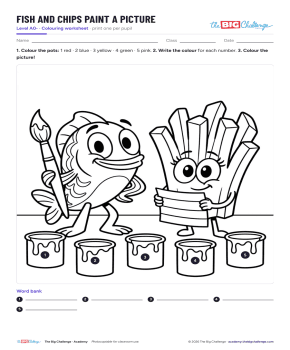
A colouring sheet for true beginners that goes with the Fish and Chips episode Paint a Picture: Fish and Chips with five numbered paint pots to colour by word (red, blue, yellow, green, pink), the colour words to write, then the picture to colour, with the teacher key on page two.
Documents to download (2)
- Colouring worksheet In your teacher account
- Colouring worksheet (black and white) In your teacher account
Teaching guide
Objective & content
A two-page printable that goes with the Fish and Chips episode Paint a Picture: five numbered paint pots, in the order Fish paints them (red, blue, yellow, green, pink), for pupils to colour by word and label, then the rest of the picture to colour, with the teacher key on page two. By the end, pupils can read and write five colour words.
Pedagogical guide
A line drawing cannot show a colour, so the pots are coloured BY the word: the sheet checks that pupils can read each colour, and the teacher key lets a teacher check the pots at a glance. All five words are A1. Watch for "yellow" (double l) and "green" (double e).
Suggested procedure
- (3 min) Play the episode's test: hold up a red pencil and ask "What colour is this?"; pupils answer "Red!" like Chips.
- (10 min) Hand out page 1. Pupils read the colour named for each pot, colour the pot, then copy the colour word onto the matching line.
- (5 min) Correct from page 2, pot by pot.
- (10 min) Colouring the rest of the picture.
Adaptations
[S] Do the test with pencils first, then let pupils colour the pots without writing the words.
[A] Fold the instructions away once the pots are coloured: pupils write each colour from memory, then check with a partner.
Materials & prerequisites
Page 1 printed for every pupil, plus coloured pencils in red, blue, yellow, green and pink. Keep page 2, the teacher key. Black and white printing still works for the rest of the scene, but the five pots need colour to be checked, so print page 1 in colour if you can.
Possible adaptations
- Lower levels: Offer segmented listening and additional visual aids.
- Advanced levels: Encourage an oral summary and a debate in English on the theme.
- Large groups: Organise group work with differentiated roles.
🔒 Restricted content
This resource requires a subscription to be viewed.
Unlock the resourceIncluded in the subscription