Reading B1+: Is the Five-Second Rule True?
Interactive exercises to consolidate your students’ learning.
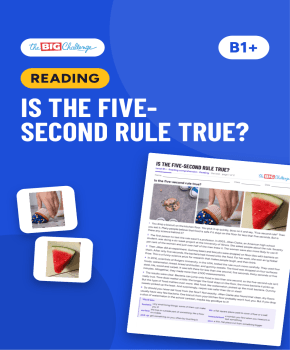
A B1+ reading about the five-second rule: is food that falls on the floor safe if you pick it up quickly? A high school student's experiment and a bigger university study give the answer. One text with a word box, ten questions and a group speaking task on testing a "rule", plus an answer key; 30 to 40 minutes.
Documents to download (2)
- Reading comprehension In your teacher account
- Reading comprehension (black and white) In your teacher account
Teaching guide
Objective & content
A B1+ reading about a "rule" everybody knows: food is safe if it stays on the floor for less than five seconds. The text tells how the rule was tested. In 2003, Jillian Clarke, an American high school student, asked people about it and then did an experiment: bacteria moved onto the food in only five seconds, and her work won an Ig Nobel Prize. In 2016, scientists at Rutgers University tested four foods on four surfaces, with more than 2,500 measurements: bacteria can jump onto food in less than one second, and wet food picks up the most. The text ends with a reassuring twist: clean, dry floors have very few bacteria. By the end, pupils can follow a short popular-science text, explain a result, and plan a simple experiment of their own. It is part of the Reading B1+ set: one-text readings with the same layout.
Pedagogical guide
The sheet has one text of about 350 words at B1+, with no sentence longer than 20 words, and a word box with six words explained in English (bacteria, tile, surface, measurement, pick up, slice). The ten questions go from finding information to explaining it: three choices or true or false first, then "Why did the watermelon pick up the most bacteria?" and "Will you still use the five-second rule? Why or why not?" The text models the passive (gummy bears were dropped, the food was left there) and the past perfect (the bacteria had moved onto the food). The speaking task puts critical thinking to work: in groups, pupils choose another "rule" many people believe and work out how they would test it. Every fact comes from the two published studies.
Suggested procedure
- (5 min) Warm-up: show the three photos and ask "Would you eat it? Why or why not?"
- (10 min) Pupils read the text alone. They can use the word box.
- (10 min) Pupils answer questions 1 to 10, then check in pairs. Correct together with the key; for 9 and 10, take two or three answers.
- (10 to 15 min) Speaking task: in groups, pupils choose another "rule" that many people believe, such as "Carrots help you see in the dark", work out how they would test it, then present their experiment to the class.
Adaptations
[S] Go through the word box first, with the photos. Before question 9, find the word "wet" in the text together. Pupils can answer questions 1 to 8 only, and present one step of their experiment.
[A] Pupils write up their experiment in the passive (The food was dropped ..., It was left ...). They can also look up another Ig Nobel Prize and explain it to the class.
Materials & prerequisites
The sheet in colour or low ink (the low-ink version has no pictures), one copy per pupil: pages 1 and 2 are for pupils, page 3 is the answer key. A screen to show the photos for the warm-up. Pupils should know the past simple and have met the passive.
Possible adaptations
- Lower levels: Offer segmented listening and additional visual aids.
- Advanced levels: Encourage an oral summary and a debate in English on the theme.
- Large groups: Organise group work with differentiated roles.
🔒 Restricted content
This resource requires a subscription to be viewed.
Unlock the resourceIncluded in the subscription