Reading B1+: Can a Mistake Make You Rich?
Interactive exercises to consolidate your students’ learning.
A B1+ reading about inventions that started as mistakes: the microwave oven and Post-it notes, and two famous stories (the ice lolly and crisps) that nobody can prove. One text with a word box, ten questions and a pair speaking task, plus an answer key; 30 to 40 minutes.
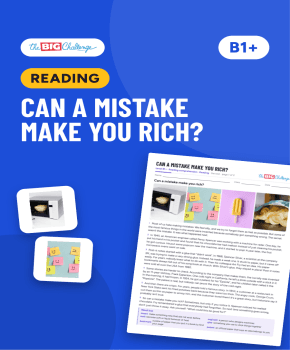
Documents to download (2)
- Reading comprehension In your teacher account
- Reading comprehension (black and white) In your teacher account
Teaching guide
Objective & content
A B1+ reading that asks whether a mistake can make you rich. The text tells four stories of things people use every day. Two are proven: in 1945, the engineer Percy Spencer found that a chocolate bar had melted in his pocket near a radar machine, which led to the microwave oven; and a weak glue that "didn't work" became Post-it notes when Art Fry used it for his bookmarks. Two are harder to check: the boy who left a drink outside on a cold night and invented the ice lolly, and the angry cook who invented crisps, a story historians say probably isn't true. The text ends with a message pupils can use: when something goes wrong, ask yourself what it could be good for. By the end, pupils can follow a short narrative text, find details, and tell a proven story from a legend. It is part of the Reading B1+ set: six one-text readings with the same layout.
Pedagogical guide
The sheet has one text of about 380 words at B1+, with no sentence longer than 20 words, and a word box with six words explained in English (invent, engineer, melt, glue, bookmark, patent). The ten questions go from finding information to thinking about it: three choices or true or false first, then "Which two stories in the text are proven, and which two are not?" and "Why does the text say 'don't just throw it away'?" The text uses the passive (were invented, was invented, were sold) and the past perfect (had melted, had frozen, had forgotten), so it works well after a lesson on the passive or on past tenses. Question 9 is a small lesson in critical thinking: not every famous story is true, and a good text says so. The speaking task asks pairs to invent something by accident and present it to the class. Every fact in the text has been checked, and the uncertain stories are presented as uncertain.
Suggested procedure
- (5 min) Warm-up: show the four photos and ask "What do these things have in common?" (They were all invented by accident, or so the story says.)
- (10 min) Pupils read the text alone. They can use the word box.
- (10 min) Pupils answer questions 1 to 10, then check in pairs. Correct together with the key; for 9 and 10, take two or three answers.
- (10 to 15 min) Speaking task: in pairs, pupils imagine a mistake that becomes a great invention (what went wrong, what they made, who would buy it), then present it to the class with the sentence starters. The class can vote for the best invention.
Adaptations
[S] Go through the word box first, and give pupils a table to fill in while they read: invention, what went wrong, proven or not. Pupils can answer questions 1 to 8 only.
[A] Pupils find the past perfect verbs in the text and explain why the writer used them. They can also look up another "accidental" invention and decide whether the story is proven.
Materials & prerequisites
The sheet in colour or low ink (the low-ink version has no pictures), one copy per pupil: pages 1 and 2 are for pupils, page 3 is the answer key. A screen to show the photos for the warm-up. Pupils should know the past simple and have met the passive.
Possible adaptations
- Lower levels: Offer segmented listening and additional visual aids.
- Advanced levels: Encourage an oral summary and a debate in English on the theme.
- Large groups: Organise group work with differentiated roles.
🔒 Restricted content
This resource requires a subscription to be viewed.
Unlock the resourceIncluded in the subscription