Reading A2: How Do Astronauts Live in Space?
Interactive exercises to consolidate your students’ learning.
An A2 reading about daily life on the International Space Station: how astronauts sleep on the wall, eat and drink, wash without a shower, use the toilet and keep fit, with 16 sunrises a day. One text with a word box, ten questions and a group speaking task, packing for space, plus an answer key; 30 to 40 minutes.
Documents to download (2)
- Reading comprehension In your teacher account
- Reading comprehension (black and white) In your teacher account
Teaching guide
Objective & content
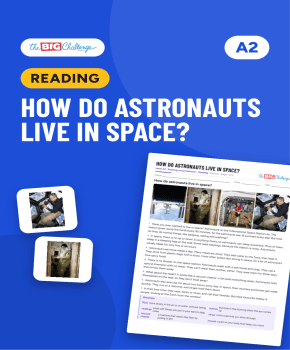
An A2 reading about everyday life on the International Space Station, which goes round the Earth every 90 minutes, so astronauts see 16 sunrises a day. In space there is no up or down: astronauts sleep in a sleeping bag on the wall, add water to dried food, drink from plastic bags with a straw, and love spicy food because food tastes less strong. There is no shower, so they wash with a wet towel; they wear their clothes for three days, then throw them away; the toilet works like a vacuum cleaner. They exercise for about two hours a day to keep their muscles and bones strong. Their favourite hobby is looking at the Earth from the window. By the end, pupils can follow a short text about a routine, find facts in a text, and explain choices with reasons. It is part of the Reading A2 set: one-text readings with the same layout.
Pedagogical guide
The sheet has one text of about 250 words at A2, with short sentences of 13 words or fewer, and a word box with six words explained in English (float, sunrise, earplugs, straw, vacuum cleaner, muscle). The ten questions go from finding information to giving an opinion: three choices, true or false and one gap to complete first, then "Why do astronauts hold themselves on the toilet seat? Explain using the text." and "Would you like to live on the space station? Why or why not?" Unlike the other sheets of the set, the text is in the present simple, because it describes a routine; it also uses "can" and "can't", and "so" for a result. The speaking task puts this to work: in groups, pupils choose five things to take for six months on the station and explain their choices. Every fact comes from the European and Japanese space agencies.
Suggested procedure
- (5 min) Warm-up: show the photos and ask "What is different about life in space?"
- (10 min) Pupils read the text alone. They can use the word box.
- (10 min) Pupils answer questions 1 to 10, then check in pairs. Correct together with the key; for 9 and 10, take two or three answers.
- (10 to 15 min) Speaking task: in groups, pupils choose five things to take for six months on the space station, with "We want to take ... because ...", "We don't need ... because ..." and "In space, you can't ...", then explain their choices to the class.
Adaptations
[S] Go through the word box first, with the photos. Before question 9, read paragraph 5 again together. Pupils can answer questions 1 to 8 only, and choose three things in the speaking task.
[A] Pupils write "A day on the space station" as an astronaut's diary, in the first person and the present simple, from the alarm in the morning to bedtime. They can also compare it with their own day using "but".
Materials & prerequisites
The sheet in colour or low ink (the low-ink version has no pictures), one copy per pupil: pages 1 and 2 are for pupils, page 3 is the answer key. A screen to show the photos for the warm-up. Pupils should know the present simple and "can".
Possible adaptations
- Lower levels: Offer segmented listening and additional visual aids.
- Advanced levels: Encourage an oral summary and a debate in English on the theme.
- Large groups: Organise group work with differentiated roles.
🔒 Restricted content
This resource requires a subscription to be viewed.
Unlock the resourceIncluded in the subscription