Mixed conditionals: The ski trip
Interactive exercises to consolidate your students’ learning.
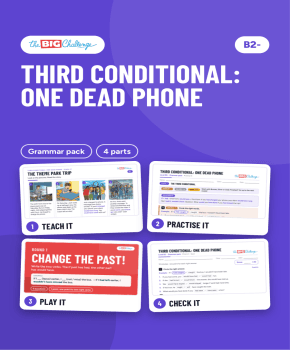
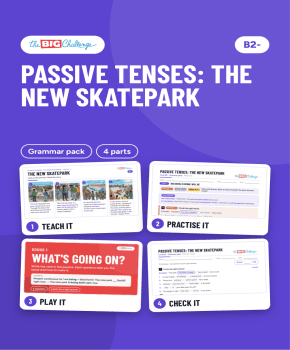
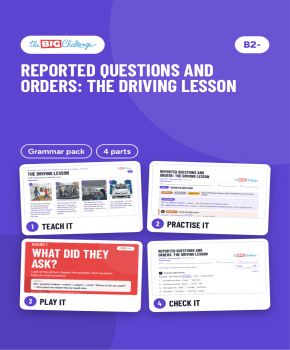
Everything to teach mixed conditionals: slides to project, a three-level practice sheet, a team game and a 10-minute quiz with answers. Last winter Leo said no to ski lessons; now, on the school ski trip, he is stuck on the beginners' slope while his friends race down the red slope. Pupils learn If + past perfect, would + verb for a past cause with a result now (If I'd taken those lessons, I'd be up there now), and If + past simple, would have + past participle for something true now that changed the past (If I weren't so stubborn, I would have said yes). The game uses funny drawings: a jumper shrunk in the wash, a boy stuck up a tree. For B2, two lessons of about 45 minutes.
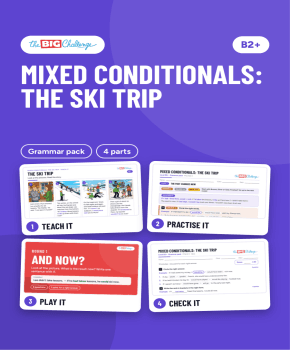
Documents to download (4)
- Teach it: lesson slides In your teacher account
- Practise it: three-level sheet In your teacher account
- Play it: team game In your teacher account
- Check it: quiz and key In your teacher account
Teaching guide
Objective & content
Everything to teach the two mixed conditionals, in one pack of four parts: slides to project, a three-level practice sheet, a team game and a 10-minute quiz with answers. The pack starts from a short story: last winter, Mum showed Leo a leaflet for ski lessons, and he said he could learn it himself. This winter, on the school ski trip, his friends race down the red slope while he watches from the bottom: "If I'd taken those lessons, I'd be up there with them now!" On the beginners' slope he falls again and again as small children ski past him, and in the end a girl of about six teaches him the snowplough. Pupils meet the patterns in the story before they meet the rule. The pack teaches If + past perfect, would + verb for a past cause with a result now (If he hadn't gone to bed so late, he wouldn't be tired now), and If + past simple, would have + past participle for something true now that changed the past (If I weren't so stubborn, I would have said yes to Mum). By the end, pupils can say how the past changes their life now, and how who they are changed what happened.
Pedagogical guide
The rule is given in Remember! boxes, not left to be deduced; the story and its pictures make the patterns easy to notice first. A third box sets the two mixed conditionals beside the third conditional, so pupils learn to ask when each half of the sentence happens; time words (last winter, yesterday, now, today) are the clue. The practice sheet is one A4 sheet at three levels: every page has a Bronze, a Silver and a Gold task, so the whole class works on the same page and each pupil moves up when they finish. Page 1 is about a past cause with a result now, page 2 about something true now with a past result, and page 3 mixes both with the third conditional; its Gold task has pupils write about their own life. The team game uses funny drawings: two friends lost in a wood with a paper map, a boy asleep in class, a jumper shrunk in the wash, a girl with a model aeroplane glued to her fingers, a boy who flips the board game when he loses. In the first round, teams write the result now; in the third round, they start from what a person is like (shy, scared of heights, allergic to horses) and write what it changed. Every round opens with a worked example. The quiz gives a mark out of 20. Was and were are both accepted after If I, he, she and it. The pack does not teach wish and if only (our pack The fake tan). The key page of the practice sheet holds the answers, teacher notes and common mistakes (for example "If I had taken lessons, I would have been better now" and "If I would have taken lessons, I would ski now"). Spelling is British English.
Suggested procedure
The pack fits two lessons of about 45 minutes. Lesson 1 is Teach it and Practise it; lesson 2 is Play it and Check it. The four parts can also be used alone.
- (25 min) Teach it (lesson.pdf, lesson 1): show the four pictures and ask "Why is Leo on the beginners' slope?", then read the story together. Read the Remember! boxes aloud; pupils say what Leo didn't do and the result now, then what Leo is like and what he didn't do. Then do the six-question quick check with the class. The last slide is for the teacher and is not projected.
- (20 min) Practise it (practice.pdf, lesson 1): give each pupil the three pages and a start (Bronze, Silver or Gold); correct page by page, with one pupil from each medal reading an answer.
- (25 min) Play it (game.pdf, lesson 2): make teams and read each round's example together. Show each question, give 20 seconds to write the answer (40 seconds in round 3), then show the answer slide and keep the score. Round 4 is worth double points.
- (10 min) Check it (quiz.pdf, lesson 2): pupils work alone on page 1; mark out of 20 with page 2.
Adaptations
[S] Start every pupil at Bronze and keep the Remember! slides on screen during the practice and the game. Give them a card with two columns, "The past changes now: If + had + past participle, would + verb" and "Now explains the past: If + past simple, would have + past participle", and do the quiz in two halves.
[A] Send fast pupils straight to Gold and then to a short paragraph of their own: three things in their past that changed their life now, and three things about who they are that changed what happened, with both mixed conditionals.
Materials & prerequisites
A projector or screen for lesson.pdf and game.pdf (one PDF page per slide, turned with the arrow keys), and paper for the teams' answers. Print practice.pdf (3 pages for pupils; the key page is for the teacher) and quiz.pdf (page 1 for pupils, page 2 is the key), one copy per pupil. Pupils should already know the past perfect and the second and third conditionals.
Possible adaptations
- Lower levels: Offer segmented listening and additional visual aids.
- Advanced levels: Encourage an oral summary and a debate in English on the theme.
- Large groups: Organise group work with differentiated roles.
🔒 Restricted content
This resource requires a subscription to be viewed.
Unlock the resourceIncluded in the subscription