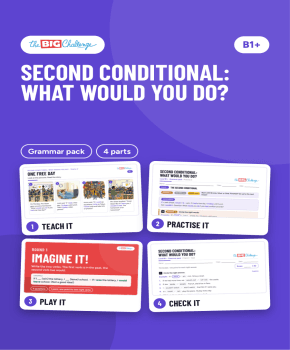
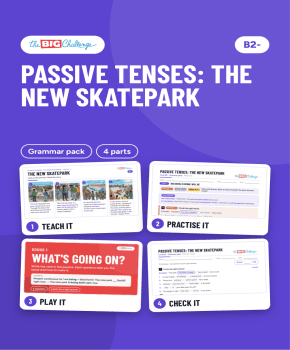
Third conditional: One dead phone
Interactive exercises to consolidate your students’ learning.
Everything to teach the third conditional: slides to project, a three-level practice sheet, a team game and a 10-minute quiz with answers. Josh plays video games until 2 a.m., forgets to charge his phone and misses the class trip to a theme park; pupils then learn If + had + past participle, would have + past participle, could have and might have, and the difference with the second conditional. The game asks what would have happened if a teenager hadn't taken a selfie next to a seagull. For B2, two lessons of about 45 minutes.
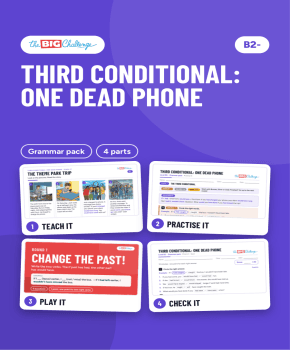
Documents to download (4)
- Teach it: lesson slides In your teacher account
- Practise it: three-level sheet In your teacher account
- Play it: team game In your teacher account
- Check it: quiz and key In your teacher account
Teaching guide
Objective & content
Everything to teach the third conditional, in one pack of four parts: slides to project, a three-level practice sheet, a team game and a 10-minute quiz with answers. The pack starts from a short story: Josh, a sixth-former, plays video games until 2 a.m. and forgets to charge his phone; his alarm doesn't ring and he misses the class trip to a theme park. His friend Amira texts him: "If you'd charged your phone, your alarm would have rung. You could have come with us!" Then it rains all afternoon and the rides close: "If you'd come, you'd have got very wet!" Pupils meet the structure in the story before they meet the rule. The pack teaches the third conditional for an imagined past (If + had + past participle, would have + past participle), the negative, the two orders and the comma, the question (What would you have done if ...?), could have and might have, 'd as had in the if part and would in the other part, and the difference with the second conditional: an imagined present (If I had a car, I'd drive to school) against an imagined past (If I'd had a car, I'd have driven to the park). By the end, pupils can talk about a past that did not happen, express regrets and choose between the second and the third conditional.
Pedagogical guide
The rule is given in Remember! boxes, not left to be deduced; the story and its pictures make the structure easy to notice first, and its ending shows that a "what if" about the past can go both ways. The practice sheet is one A4 sheet at three levels: every page has a Bronze, a Silver and a Gold task, so the whole class works on the same page and each pupil moves up when they finish. The team game is written for teenagers, with funny drawings of small disasters: a seagull steals a girl's chips while she takes a selfie, a dog eats the pizza, a boy sits on the birthday cake, and in one round teams say what they would have done if their trousers had ripped on stage. Teams score a point for a correct sentence and, in that round, one more for the best idea. Every round opens with a worked example. The quiz gives a mark out of 20. The pack stays at early B2 level: no mixed conditionals, no I wish or if only and no past perfect continuous. The key page of the practice sheet holds the answers, teacher notes and seven common mistakes (for example "If I would have known", "I would helped her" and "we would have went"). Spelling is British English.
Suggested procedure
The pack fits two lessons of about 45 minutes. Lesson 1 is Teach it and Practise it; lesson 2 is Play it and Check it. The four parts can also be used alone.
- (25 min) Teach it (lesson.pdf, lesson 1): show the four pictures and ask "Why did Josh miss the trip? Was he lucky in the end?", then read the story together. Read the Remember! boxes aloud; pupils find every had and would have in the story and say what each 'd means in pictures 3 and 4. Say a sentence: pupils show two fingers for the second conditional, three for the third. Then do the six-question quick check with the class. The last slide is for the teacher and is not projected.
- (20 min) Practise it (practice.pdf, lesson 1): give each pupil the three pages and a start (Bronze, Silver or Gold); correct page by page, with one pupil from each medal reading an answer.
- (25 min) Play it (game.pdf, lesson 2): make teams and read each round's example together. Show each question, give 20 seconds to write the answer (one minute in round 3, where the class votes for the best idea), then show the answer slide and keep the score. Round 4 is worth double points.
- (10 min) Check it (quiz.pdf, lesson 2): pupils work alone on page 1; mark out of 20 with page 2.
Adaptations
[S] Start every pupil at Bronze and keep the Remember! slides on screen during the practice and the game. Give them a card with the pattern (If + had + past participle, would have + past participle) and a list of the irregular past participles they need (gone, taken, seen, eaten, fallen), and do the quiz in two halves.
[A] Send fast pupils straight to Gold and then to the Gold writing task on page 3, where they write about a day that went wrong and what would have been different, and read it to a partner, who asks one more question (What would you have done if ...?). In round 3 of the game, ask them for two or three sentences instead of one.
Materials & prerequisites
A projector or screen for lesson.pdf and game.pdf (one PDF page per slide, turned with the arrow keys), and paper for the teams' answers. Print practice.pdf (3 pages for pupils; the key page is for the teacher) and quiz.pdf (page 1 for pupils, page 2 is the key), one copy per pupil. Pupils should already know the past perfect, the past participles of common irregular verbs and the second conditional (If I had a car, I'd drive to school).
Possible adaptations
- Lower levels: Offer segmented listening and additional visual aids.
- Advanced levels: Encourage an oral summary and a debate in English on the theme.
- Large groups: Organise group work with differentiated roles.
🔒 Restricted content
This resource requires a subscription to be viewed.
Unlock the resourceIncluded in the subscription