Short story: The Interlopers
Interactive exercises to consolidate your students’ learning.
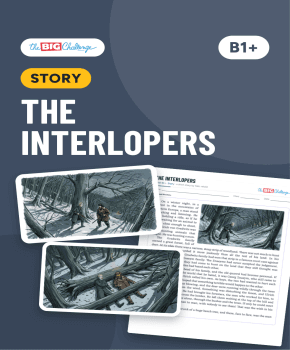
The Interlopers by Saki (1919), retold at B1+ with the story untouched: for three generations, two families in the mountains of Eastern Europe have fought over one narrow strip of forest. On a stormy winter night, the two enemies, Ulrich and Georg, meet face to face among the trees, each with a rifle in his hand. Before either can act, a huge beech tree falls and traps them both. Lying side by side in the cold, waiting to see whose men will come first, they begin to talk. Four pages of story with pictures, then six choice questions, four questions to think about the story and its title, a box and gap fill on three verb forms from the story, and an invitation to write; answer key and teacher notes included, in colour and in black and white. One long lesson or two short ones.
Documents to download (2)
- Worksheet In your teacher account
- Worksheet (black and white) In your teacher account
Teaching guide
Objective & content
The Interlopers by Saki (1919), retold at B1+. The language is simplified, the story is not: the ending is Saki's, and it is left open. For three generations, the von Gradwitz and Znaeym families have fought over one narrow strip of forest in the mountains of Eastern Europe. On a stormy winter night, Ulrich von Gradwitz goes looking for his enemy, Georg Znaeym, and finds him beside a huge beech tree. Each man has a rifle in his hand, but before either can act, the tree falls and traps them both. Lying side by side in the cold, they threaten each other, then slowly begin to talk, while they wait to see whose men will arrive first. By the end, pupils can follow a story of about 1,500 words and explain how two enemies change their minds, and why the last word of the story is such a shock.
Pedagogical guide
The story runs over four pages, set like a novel, with one drawing on each page. The last picture shows the ending, so keep page 4 face down until the class has guessed whose men arrive first. Page 5 holds the tasks. Six choice and true or false questions check the story. "Think about the story" asks what each man first planned to do, what made Ulrich change his mind, who really comes between the two men, and why the ending is so cruel; the title word, "interloper", means an outsider who comes in where he is not wanted. A box gives three verb forms from the story (the past continuous, the past perfect and the second conditional), then pupils complete four sentences from the story with them. In the last task, pupils write the invitation Georg imagines sending to his new friend, using "would". Page 6 is the answer key with the teacher notes. Both men carry rifles, but nobody shoots, and the ending is only suggested.
Suggested procedure
- (5 min) Ask "Have you ever had a long argument with someone? How did it end?"
- (20 min) Read the story aloud, or pupils read in pairs. Stop after "came down on top of them." and ask "What do you think will happen now?" Stop again at the end of page 3 and ask "Whose men do you think will arrive first?", then read page 4.
- (10 min) Pupils answer the choice questions, then the "Think about the story" questions; check together.
- (10 min) Pupils read the box and complete the four sentences.
- (15 min) Pupils write Georg's invitation; a few pupils read theirs aloud.
Adaptations
[S] Read the story over two lessons, two pages at a time, and go through the words they may need first (rifle, forester, quarrel, trapped, flask, feast). Pupils can answer the choice questions and two of the "Think about the story" questions only.
[A] Pupils write a different last page: this time, Ulrich's men arrive first. What do the two new friends say and do next?
Materials & prerequisites
One copy per pupil, in colour or black and white: pages 1 to 5 are for pupils, page 6 is the answer key. Pupils should know the past simple and the past continuous.
Possible adaptations
- Lower levels: Offer segmented listening and additional visual aids.
- Advanced levels: Encourage an oral summary and a debate in English on the theme.
- Large groups: Organise group work with differentiated roles.
🔒 Restricted content
This resource requires a subscription to be viewed.
Unlock the resourceIncluded in the subscription