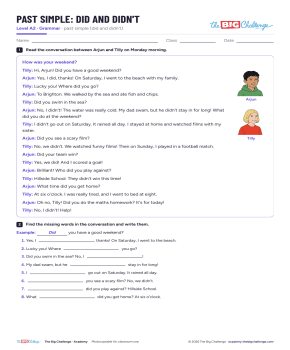
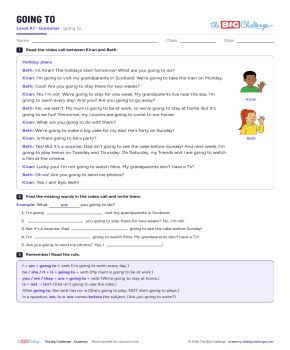
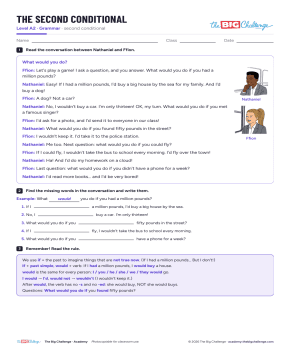
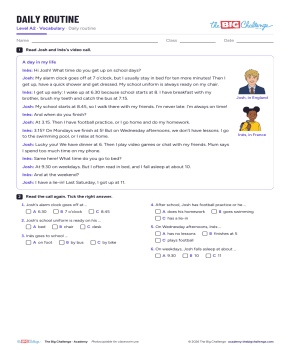
Must and mustn't
Interactive exercises to consolidate your students’ learning.
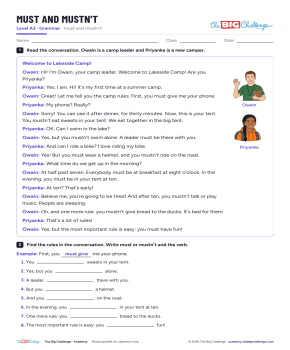
Rules with must and mustn't, the same form for every person and no -s or to after must, seen through a conversation in which Owain, a camp leader, tells Priyanka the rules of Lakeside Camp. Pupils find the rules, read the rule box, choose must or mustn't, turn signs into rules, tick the right sentences, complete Priyanka's letter and write rules for their classroom; answer key included.
Documents to download (2)
- Colour version In your teacher account
- Black and white version In your teacher account
Teaching guide
Objective & content
This grammar sheet teaches must + verb and mustn't + verb to give and understand rules: must says "do it", mustn't says "don't do it", the form is the same for every person, and the verb after must has no -s and no to (She must wear a helmet). Pupils read a conversation in which Owain, a camp leader, tells Priyanka, a new camper, the rules of Lakeside Camp, find the rules and read the rule, given in a box. By the end, they can understand the rules of a place and write rules of their own.
Pedagogical guide
Page 1 is the conversation, with a picture of Owain and of Priyanka: campers must give their phone to the leader, mustn't eat sweets in their tent, mustn't swim alone, must wear a helmet on a bike, must be in their tent at ten and mustn't give bread to the ducks. Pupils find eight rules in the conversation and write must or mustn't with the verb. Page 2 has the rule, given in a box in short lines (it includes "we don't say the first t in mustn't"), eight sentences where pupils tick must or mustn't, and eight signs (NO DOGS!, WASH YOUR HANDS!) to turn into rules with the verb in brackets. Page 3 has six pairs of sentences where pupils tick the right one (She must wear, not She must wears), then Priyanka's letter to her grandparents with ten words to circle: must or mustn't, and the verb after must. The last task: pupils write four rules for their classroom, two with must and two with mustn't. Every exercise opens with a worked example, except the classroom rules. The answer key accepts both mustn't and must not.
Suggested procedure
- (5 min) Ask the class "What are the rules in our school?" and write two of them on the board: "You must be on time. You mustn't run in the corridors."
- (10 min) Read the conversation aloud; pupils find the rules.
- (5 min) Read the rule in the box with the class; say mustn't together.
- (10 min) Page 2: pupils tick must or mustn't, then turn the signs into rules.
- (10 min) Page 3: pupils tick the right sentences, then circle the words in Priyanka's letter.
- (5 min) Pupils write four classroom rules and read them to the class.
- (5 min) Check with the answer key on page 4.
Adaptations
[S] Pupils read the conversation aloud in pairs, one as Owain and one as Priyanka, before the tasks.
[A] Pupils write four rules for their bedroom, two with must and two with mustn't.
Materials & prerequisites
One copy of pages 1 to 3 per pupil. Page 4 is the answer key and teacher notes: keep it. Pupils need the present simple, can for what is allowed, and the time. To take it further, groups make a poster of rules for an invented place (a school for dragons, a hotel for cats) and present it to the class.
Possible adaptations
- Lower levels: Offer segmented listening and additional visual aids.
- Advanced levels: Encourage an oral summary and a debate in English on the theme.
- Large groups: Organise group work with differentiated roles.
🔒 Restricted content
This resource requires a subscription to be viewed.
Unlock the resourceIncluded in the subscription