Fortune Teller
Interactive exercises to consolidate your students’ learning.
Pupils colour, cut out and fold a paper fortune teller, then play with it in pairs. They spell a colour, count to a number and open a flap on a challenge such as "Can you hop on one leg?": the friend answers "Yes, I can!" and does it, or "No, I can't!". Answer key and folding steps included.
Teaching guide
Objective & content
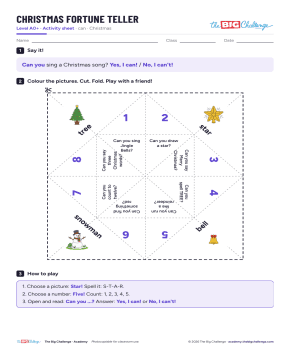
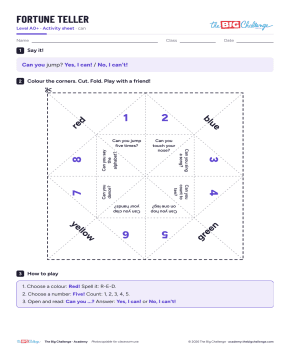
Pupils make a paper fortune teller and play with it in pairs. The four corners are red, blue, green and yellow, and under the flaps are eight challenges, each a question with can: "Can you jump five times?", "Can you touch your nose?", "Can you sing a song?", "Can you count to ten?", "Can you hop on one leg?", "Can you clap your hands?", "Can you dance?" and "Can you say the alphabet?". By the end, pupils ask and answer with can: "Can you dance?" "Yes, I can!" or "No, I can't!"
Pedagogical guide
The sheet has three parts. "Say it!" gives the model exchange: "Can you jump? Yes, I can! / No, I can't!". Task 2 is the fortune teller itself, a square with fold lines, the four colours, the numbers 1 to 8 and the eight questions, ready to colour, cut out and fold. "How to play" gives the three steps in English: choose a colour and spell it (R-E-D), choose a number and count, then open, read the question and answer. The game recycles colours, spelling and numbers while the target structure comes back with every turn. Every challenge is something a child can do in the classroom, so "Yes, I can!" is followed by the action itself. Page 2 lists the eight questions in order and gives the folding steps in the teacher notes; any answer is right if the pupil uses Yes, I can or No, I can't.
Suggested procedure
- (5 min) Read "Say it!" together and practise the eight questions aloud as a class.
- (5 min) Pupils colour each corner in its colour.
- (5 min) Pupils cut out the square along the dashed line.
- (10 min) Fold the fortune teller with the class, step by step (the steps are in the teacher notes on page 2).
- (10 min) In pairs, pupils play: the friend picks a colour, a number, then a number again, hears the question and answers "Yes, I can!" and does it, or "No, I can't!". Then they swap.
Adaptations
[S] Practise the eight questions aloud as a class before playing, and keep "Yes, I can! / No, I can't!" on the board.
[A] Pupils make a second fortune teller on a blank square with their own "Can you ...?" questions.
Materials & prerequisites
One copy per pupil of page 1, in colour or black and white. Each pupil needs scissors and colouring pencils in red, blue, green and yellow. Page 2 is the answer key with the folding steps: keep it, and fold one fortune teller yourself before the lesson to show the class. Pupils should know the four colours, the numbers one to ten and the names of the letters, for spelling.
Possible adaptations
- Lower levels: Offer segmented listening and additional visual aids.
- Advanced levels: Encourage an oral summary and a debate in English on the theme.
- Large groups: Organise group work with differentiated roles.