How Did the War Start?
Episode of the series The American Revolution, Explained
- Illustrated slideshow (22 images)
- Glossary (25 words)
- Comprehension quiz (17 questions)
- 20 cultural notes
 Extract · 30 s
The episode
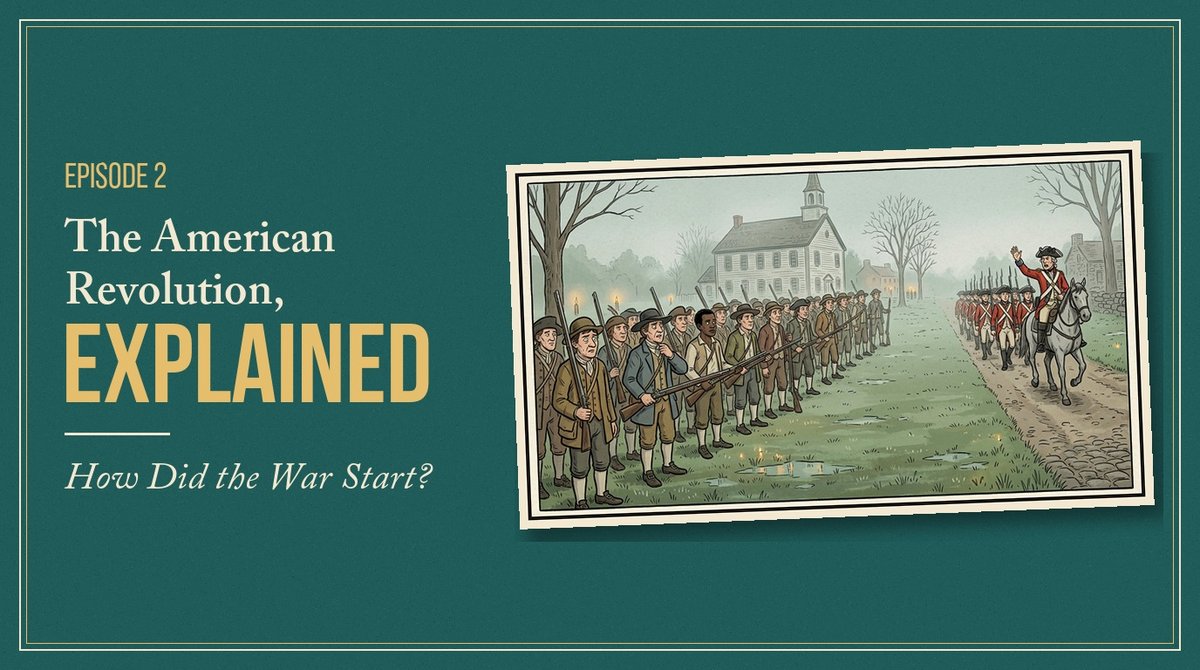
In April 1775 the argument of episode 1 turned into shooting. The British army in Boston, on orders from London, marched to Concord to take the colonists' guns; riders warned the towns; on Lexington Green someone fired a shot, and nobody knows who. By June the colonies' militias surrounded Boston, the British won a costly battle at Bunker Hill (on Breed's Hill), and Congress chose George Washington to lead one army for all the colonies. Then the two sides raced to tell Britain their story, and the colonists' little ship won.
Episode worksheets (2)
- Student sheet In your teacher account
- Teacher sheet In your teacher account
Teaching guide
Objective & content
Two hosts, one American and one British, explain how the quarrel between Britain and its colonists turned into a war in 1775. Everybody knows the first shot of the war, but nobody knows who fired it, not even historians. The hosts follow the steps: the British army hears about the colonists' hidden guns, riders including Paul Revere warn the colonists, soldiers and colonists meet at Lexington, the colonists fight back on the road to Boston, thousands surround the army, the colonists' leaders choose George Washington to lead one army, and two days later Bunker Hill is fought. The twist is a newspaper race: the colonists' ship reached London almost two weeks before the general's report, so London read their story first. Learners practise the past simple (hid, heard, fired, chose) and the grammar of explaining: so and but, before and after, who and which, reporting with said, comparing, and How and Why questions. They listen for dates and names, then answer the quiz in the app and the one-page pupil sheet.
Pedagogical guide
The 45-minute lesson plan starts from a puzzle: who fired the first shot of the war? Learners guess, listen twice (once for the answer, once with four pauses for short questions), then practise facts, vocabulary and the grammar of explaining. The two hosts are equals who each bring their own country's view ("a proud fight" for Americans, "a win" for the British army), so the class can discuss how each side tells the same story. The fighting is told briefly and factually: keep the talk on who fired first and who told the story first, not on the casualties. The idea to repeat is that nobody can prove who fired first, and that the story that arrived first in London mattered. Most activities have a support path and a stretch path.
Suggested procedure
- Activate knowledge (3 min): write 1775 and the first shot on the board and collect guesses about who fired first.
- Vocabulary preview (5 min): army, gun, hide, warn, rider, mystery, prove, report.
- First listen (8 min): play the whole episode (about 4 minutes 54 seconds, with the theme tune and the hosts' hello) and ask whether the hosts know who fired first.
- Second listen (10 min): pause four times, after "No guns, no fighting.", after "Not then, and not now.", after "Nobody could get out by land." and after "Almost two weeks faster!", to ask short questions.
- Comprehension check (5 min): the Facts part of the pupil sheet (questions 1 to 6, as in the app quiz).
- Vocabulary practice (4 min): the Vocabulary part (questions 7 to 12).
- Grammar focus (6 min): join facts with so, because, but, before and after, notice who and which, report with said, compare, then the Grammar part (questions 13 to 18).
- Speaking (4 min): in pairs, students play the two hosts and ask and answer questions with Who, Why and How, ending on the newspaper race.
Materials & prerequisites
- The episode in the app, with its quiz.
- The one-page pupil sheet (18 items: facts, vocabulary, grammar) and its answer key, in the episode's printables.
- Prerequisites: the past simple, was and were, and the connectors so and but.
Possible adaptations
- Lower levels: Offer segmented listening and additional visual aids.
- Advanced levels: Encourage an oral summary and a debate in English on the theme.
- Large groups: Organise group work with differentiated roles.
🔒 Restricted content
This resource requires a subscription to be viewed.
Unlock the resourceIncluded in the subscriptionTags
- Documentary
- Past simple: regular verbs
- Past simple: irregular verbs
- Past simple: was / were
- Past continuous
- Negation: do / does / did
- Logical connectors
- Relative pronouns
- Direct and indirect speech
- Historical dates
- Famous people
- Society & politics
- American Revolution
- Encountering others
- Listening comprehension
- Cultural awareness
- Vocabulary building
- Modern history
- Past & Progress