Why Did They Declare Independence?
Episode of the series The American Revolution, Explained
- Illustrated slideshow (25 images)
- Glossary (26 words)
- Comprehension quiz (17 questions)
- 21 cultural notes
 Extract · 30 s
The episode
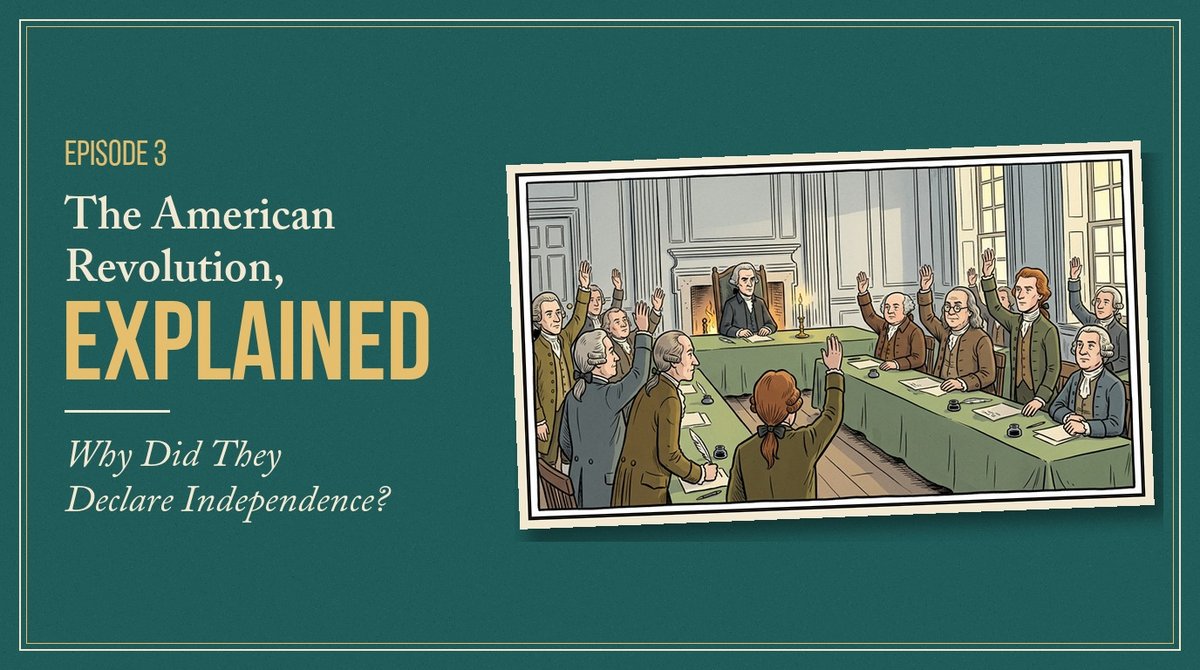
In 1775 the colonists in America still said they were loyal to the king; one year later they voted to leave Britain. The door closed from London: King George the Third called them rebels and Parliament in London cut off their trade, and in January 1776 a cheap little book, Common Sense, written by a man who had arrived from England only a year before, told them they did not need a king at all. Congress voted for independence on 2 July 1776 and approved the words of the Declaration on 4 July. Its most famous sentence says "all men are created equal", but its writer, Thomas Jefferson, enslaved people, and in 1776 those words did not include everyone. Later, many people used the same words to ask for equal rights.
Episode worksheets (2)
- Student sheet In your teacher account
- Teacher sheet In your teacher account
Teaching guide
Objective & content
Two hosts, one American and one British, explain why the colonists in the British colonies in America declared independence in 1776. At first most still loved the king, but King George called them rebels, Parliament stopped all trade, and Thomas Paine, an Englishman who had arrived in America about a year before, wrote Common Sense. Thomas Jefferson then wrote the Declaration of Independence, and the hosts tell the hard part briefly and factually: "All men are created equal" did not include enslaved people, women or Native Americans in 1776, Jefferson himself enslaved hundreds of people, and later Martin Luther King used the same words to ask for equality. The twist is the date: the vote was on 2 July, Congress agreed the final words on the fourth, and John Adams got the date wrong by two days. Learners practise the past simple and the grammar of explaining (so, because and but, before and after, who and which, reporting with would, the superlative, Why questions), listen for dates and names, then answer the quiz in the app and the one-page pupil sheet.
Pedagogical guide
The 45-minute lesson plan starts from a question: was the Fourth of July the day of the big vote for independence? Learners guess, listen twice (once for the answer, once with four pauses for questions), then practise facts, vocabulary and the grammar of explaining. The two hosts are equals who each bring their own country's view, so the class can discuss what a pupil's own country learns about this story. The passage on slavery is short and sober: say it as the hosts do ("Both things are true"), without blaming or defending anyone, and keep the talk on what came later, when people used the same words to ask for equality. The idea to repeat is that at first the colonists loved the king, and then a small book said the problem was kings. Most activities have a support path and a stretch path.
Suggested procedure
- Activate knowledge (3 min): ask what the Fourth of July is in the United States, then whether 4 July 1776 was the day of the big vote.
- Vocabulary preview (5 min): king, polite, enemy, rebel, complaint, bonfire, president, equal.
- First listen (8 min): play the whole episode (about 4 minutes 55 seconds, with the theme tune and the hosts' hello) and ask whether the guess was right.
- Second listen (10 min): pause four times, after "Now the king was the enemy too", after "I'm not sure London thanked him", after "Now the enemy was the king", and after "So the words became bigger than the man who wrote them", to ask short questions.
- Comprehension check (5 min): the Facts part of the pupil sheet (questions 1 to 6, as in the app quiz).
- Vocabulary practice (4 min): the Vocabulary part (questions 7 to 12).
- Grammar focus (6 min): join facts with so, because, before and after, notice who and which, report with would, add the superlative and Why questions, then start the Grammar part (questions 13 to 18).
- Speaking (4 min): in pairs, students play the two hosts and ask and answer questions with Why, When and Who.
Materials & prerequisites
- The episode in the app, with its quiz.
- The one-page pupil sheet (18 items: facts, vocabulary, grammar) and its answer key, in the episode's printables.
- Prerequisites: the past simple, was and were, years and dates in English, and simple linking with and and but.
Possible adaptations
- Lower levels: Offer segmented listening and additional visual aids.
- Advanced levels: Encourage an oral summary and a debate in English on the theme.
- Large groups: Organise group work with differentiated roles.
🔒 Restricted content
This resource requires a subscription to be viewed.
Unlock the resourceIncluded in the subscriptionTags
- Documentary
- Past simple: regular verbs
- Past simple: irregular verbs
- Past simple: was / were
- want / would like to
- Logical connectors
- Relative pronouns
- Direct and indirect speech
- Government
- Society & politics
- Historical dates
- Civil rights
- American Revolution
- Independence Day
- Encountering others
- Listening comprehension
- Cultural awareness
- Vocabulary building
- Citizenship & society
- Modern history
- Our World
- Past & Progress