Two Truths and a Lie: Ice-breaker
A teaching resource designed to energise your English lessons.
A zero-prep 10-minute ice-breaker where students share two truths and a lie and classmates ask follow-up questions to spot it.
Teaching guide
Objective & content
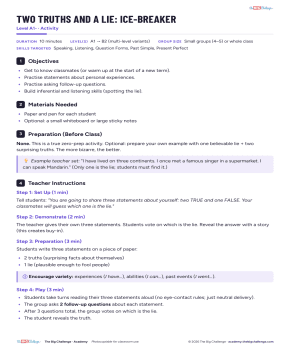
A zero-prep 10-minute ice-breaker for the first lesson of term or a new group. Each student shares three statements — two true, one false — and classmates ask follow-up questions to spot the lie. By the end, students have practised personal statements and question forms while getting to know each other. Four level variants scale the grammar focus: A1 present simple, A2 past simple, B1 present perfect, B2 mixed tenses with indirect questions.
Pedagogical guide
Run this before any grammar teaching starts — it needs no materials and works with a group that has never met. It doubles as a diagnostic: listening to the statements and questions shows you each student's starting fluency. Model your own three statements first (make the lie plausible, the truths surprising) to set a safe, playful tone before students write their own.
Suggested procedure
- (1 min) Explain: each student writes two true statements and one false one.
- (2 min) Teacher demonstrates with their own three statements; class votes on the lie.
- (3 min) Students write their three statements individually or in pairs.
- (3 min) Students take turns reading their statements; the group asks two follow-up questions each, then votes on the lie.
- (1 min) Quick "best lie" / "most surprising truth" round; share 1–2 strong follow-up questions with the class.
Adaptations
- [S] Provide sentence frames ("I have a ___", "I can ___"); allow gestures and photos; only one yes/no follow-up question; skip voting if it adds pressure.
- [A] Require abstract claims and mixed tenses; one follow-up must be an indirect question ("Could you tell me how…?"); the "liar" extends their lie into a 3-sentence story for the next round.
Materials & prerequisites
Paper and pen per student; no other materials. No prerequisite grammar at A1 (present simple "I have/I like"); A2/B1 need past simple and present perfect already introduced.
Assessment & extensions
Use the follow-up questions you capture as material for a future question-formation lesson. Extend with a "posted-online" variant (short home videos) or a class-detective version where the teacher reads statements anonymously and the class guesses the author.
Possible adaptations
- Lower levels: Offer segmented listening and additional visual aids.
- Advanced levels: Encourage an oral summary and a debate in English on the theme.
- Large groups: Organise group work with differentiated roles.