What can you do?
A teaching resource designed to energise your English lessons.
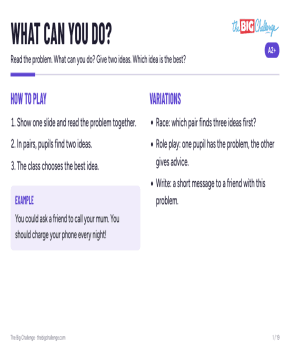
A projectable A2+ speaking warm-up: 18 everyday teen problems, from a dead phone battery to a lost dog. In pairs, pupils give two pieces of advice with could and should, then the class chooses the best idea.
Documents to download (1)
- Slide bank In your teacher account
Teaching guide
Objective & content
By the end, A2+ pupils can give advice on an everyday problem with You could ..., You should ... and Why don't you ...?, and say which idea is the best. The bank is 19 projectable slides: a how-to slide, then 18 pictured problems from the life of teenagers, such as a dead phone battery, a missed bus or a forgotten birthday.
Pedagogical guide
Use it as a five-minute speaking warm-up. The problems are small and familiar, so pupils have ideas at once and the effort goes into the language of advice. Asking for two ideas per pair, then a class choice (I think the best idea is ... because ...), adds a reason and a comparison. The slides are interchangeable: show one or two per lesson.
Suggested procedure
- (1 min) Show the how-to slide and read the example together.
- (1 min) Show one problem and read it together.
- (2 min) In pairs, pupils find two ideas with You could ... and You should ....
- (1 min) Pairs share their ideas; the class chooses the best one.
Adaptations
- [S] Race: which pair finds three ideas first? Pupils can give short ideas from the starters.
- [A] Role play: one pupil has the problem, the other gives advice. Or pupils write a short message to a friend with this problem.
Materials & prerequisites
A projector or screen; the bank is a 16:9 PDF, one slide per page, with no printing needed. Assumes could and should for advice, Why don't you ...?, and the present perfect in short forms (you haven't studied).
Curriculum alignment
Maps to Cycle 3 "child and close environment" and Cycle 4 "encountering others" (FR): talking about everyday problems and helping others.
Possible adaptations
- Lower levels: Offer segmented listening and additional visual aids.
- Advanced levels: Encourage an oral summary and a debate in English on the theme.
- Large groups: Organise group work with differentiated roles.
🔒 Restricted content
This resource requires a subscription to be viewed.
Unlock the resourceIncluded in the subscription