Would you rather...?
A teaching resource designed to energise your English lessons.
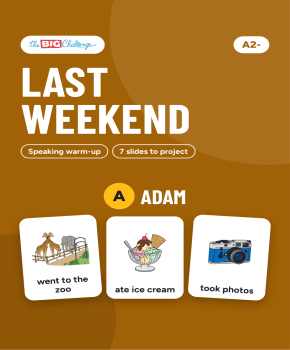
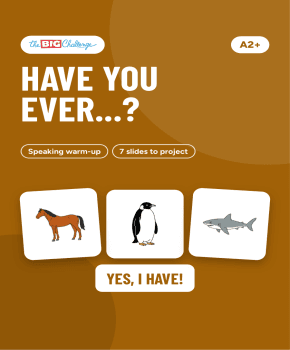
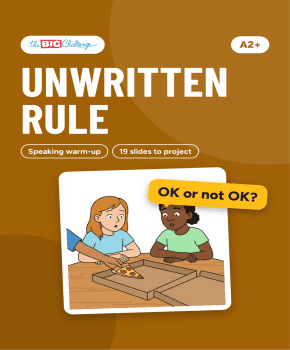
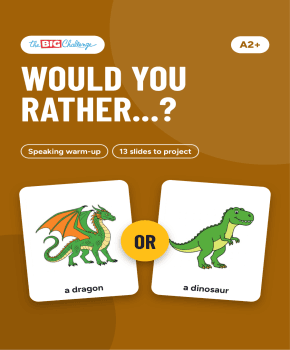
A projectable A2+ speaking warm-up: 12 Would you rather questions with two pictures each, such as having a pet dragon or a pet dinosaur. Pupils choose, give a reason with I'd rather ... because ..., and try to change their classmates' minds.
Documents to download (1)
- Slide bank In your teacher account
Teaching guide
Objective & content
By the end, A2+ pupils can state a preference and justify it with I'd rather ... because ... and I wouldn't like to ... because ...: I'd rather live by the sea because I love swimming. The bank is 13 projectable slides: a how-to slide, then 12 Would you rather questions (a pet dragon or a pet dinosaur, never eat pizza again or never eat chocolate again, a library or a cinema in your bedroom...), each with two pictures and the useful phrases.
Pedagogical guide
Use it as a five-minute warm-up that gets everyone talking. Every pupil has an opinion on these questions, and the class rarely agrees, so pupils have a real reason to explain their choice and to listen to the other side. Asking each side for its best reason, then checking if anyone changed their mind, turns a simple vote into a short debate. The slides are interchangeable: show one or two per lesson.
Suggested procedure
- (1 min) Show the how-to slide and read the example together.
- (2 min) Show one question. Pupils choose and tell a partner why, with I'd rather ... because ....
- (2 min) Count the hands for each side. Each side gives its best reason. Does anyone change their mind?
Adaptations
- [S] Give pupils two or three reasons to choose from (because it's fun, because it's dangerous), so they only need to build I'd rather ....
- [A] Two pupils, one for each side, have thirty seconds each to win the class over, or pupils write a new question for the class.
Materials & prerequisites
A projector or screen; the bank is a 16:9 PDF, one slide per page, with no printing needed. Assumes would in questions and because for reasons.
Possible adaptations
- Lower levels: Offer segmented listening and additional visual aids.
- Advanced levels: Encourage an oral summary and a debate in English on the theme.
- Large groups: Organise group work with differentiated roles.
🔒 Restricted content
This resource requires a subscription to be viewed.
Unlock the resourceIncluded in the subscription