A four-day school week?
Interactive exercises to consolidate your students’ learning.
Writing a for-and-against essay, seen through Ines's essay on whether schools should switch to a four-day week: an introduction that presents the debate, a paragraph for, a paragraph against and a conclusion with an alternative. Pupils answer questions on the essay, read the useful phrases, match words from the text to their meanings, complete sentences with linkers, then write about the four-day week or a debate from a card (exams or coursework, video games at the Olympics, a tax on fast fashion, a volunteering year) and tick a checklist; model essay and answer key included.
Documents to download (2)
- Worksheet In your teacher account
- Worksheet (black and white) In your teacher account
Teaching guide
Objective & content
This writing sheet teaches pupils to write a for-and-against essay (an introduction that presents the debate; On the one hand..., What is more...; On the other hand..., In addition...; In conclusion, although..., I believe the disadvantages outweigh the advantages; Rather than...). Pupils read Inès's essay on the four-day school week, take its structure and phrases and write their own. By the end, they can write a balanced essay of 180 to 250 words with an opinion and an alternative.
Pedagogical guide
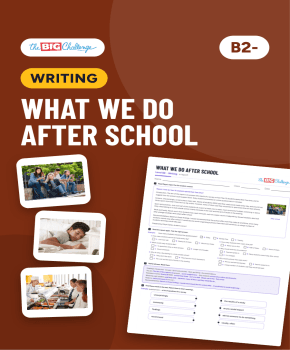
Page 1 has Inès's essay, with a photo of tired pupils at their desks. Some schools, including parts of the United States, have moved to a four-day week with longer days. Inès weighs the benefits (rest, sleep, time for family and hobbies, money saved on heating and buses) against the drawbacks (tiring days, concentration dropping in the afternoon, childcare for working parents, pupils who struggle falling behind), concludes against it and suggests starting school later instead. Pupils answer six questions with three options each, read the useful phrases, set out in the order of the essay (introduction, for, against, conclusion, an alternative), and match five words from the text to their meanings. Page 2 starts with four sentences to complete with However, What is more, Although and Rather than. Then pupils write about the four-day week or a debate from a card (exams or coursework, video games at the Olympics, a tax on fast fashion, a volunteering year, each with two points for and two against), and tick the checklist. The answer key gives a model essay on exams and coursework. The card debates are new; the four-day week also appears in the B1 "Big questions" debate cards, so this sheet can follow that discussion at a higher level.
Suggested procedure
- (5 min) Ask "Would you like a four-day school week? Why?" and note arguments for and against.
- (10 min) Read the essay aloud; pupils answer the questions.
- (10 min) Read the useful phrases with the class; pupils do the word match and underline the linkers.
- (5 min) Page 2: pupils complete the sentences.
- (25 min) Pupils choose a debate, write the essay and tick the checklist.
- (5 min) Pupils read only their conclusion; the class votes for the most convincing one.
Adaptations
[S] Pupils write one paragraph for each line of the phrases box, using the two points for and against on the card.
[A] Pupils add a statistic or an example to each paragraph.
Materials & prerequisites
One copy of pages 1 and 2 per pupil. Page 3 is the answer key, the model essay and the teacher notes: keep it. Pupils need linkers of addition and contrast, could, would and might. To take it further, the class holds the debate, then pupils rewrite their conclusion.
Possible adaptations
- Lower levels: Offer segmented listening and additional visual aids.
- Advanced levels: Encourage an oral summary and a debate in English on the theme.
- Large groups: Organise group work with differentiated roles.
🔒 Restricted content
This resource requires a subscription to be viewed.
Unlock the resourceIncluded in the subscription