Save our youth centre
Interactive exercises to consolidate your students’ learning.
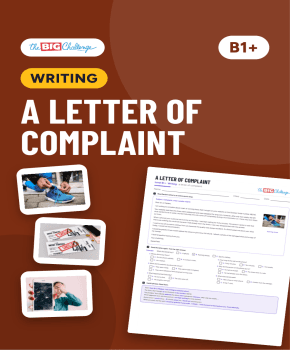
Writing a formal letter to the council, seen through Priya's letter against the closure of her town's youth centre: why she is writing, why the centre matters, the council's point and her answer, a proposal and a polite request. Pupils answer questions on the letter, read the useful phrases, match words from the text to their meanings, complete formal sentences, then write about a local problem from a card (an unlit cycle path, a cancelled bus, shorter library hours, a skate park to be closed) or a real one and tick a checklist; model letter and answer key included.
Documents to download (2)
- Worksheet In your teacher account
- Worksheet (black and white) In your teacher account
Teaching guide
Objective & content
This writing sheet teaches pupils to write a formal letter to the council about a local problem (I am writing on behalf of... to express our concern about...; For over twenty years, ... has been far more than...; Had it not been for..., I doubt I would have...; We understand that... However,...; We would therefore like to propose an alternative. Rather than..., the council could...; I would be grateful if you could...; I enclose...; Yours sincerely). Pupils read Priya's letter, take its structure and phrases and write their own. By the end, they can write a persuasive formal letter of 200 to 250 words with an argument, a proposal and a request.
Pedagogical guide
Page 1 has Priya's letter, with a photo of teenagers playing table tennis. On behalf of the Northfield Youth Council, Priya writes to a councillor about the planned closure of the youth centre: for twenty years it has been the only safe place for teenagers to meet in the evening, with free activities, and its mentoring scheme helped her pass her exams. She accepts that the council must save money, argues that closing the centre will cost more in the long run, proposes sharing the building with other groups and local sponsors, asks for a meeting and encloses a petition of 800 signatures. Northfield and the people are made up. Pupils answer six questions with three options each, read the useful phrases, set out in the order of the letter, and match five words from the text to their meanings. Page 2 starts with four formal sentences to complete (an inversion, a mixed conditional, a passive, Rather than, on behalf of). Then pupils write about a problem from a card (an unlit cycle path, a cancelled bus route, shorter library hours, a skate park to be closed, each with facts and an idea) or a real problem in their town, and tick the checklist. The answer key gives a model letter about the cycle path.
Suggested procedure
- (5 min) Ask "What would you change in our town if you could?" and list the problems.
- (10 min) Read the letter aloud; pupils answer the questions.
- (10 min) Read the useful phrases with the class; pupils do the word match and find the polite request.
- (5 min) Page 2: pupils complete the sentences.
- (25 min) Pupils choose a problem, write the letter and tick the checklist.
- (5 min) In pairs, one pupil reads the letter and the other, as the councillor, gives a first answer.
Adaptations
[S] Pupils follow Priya's letter paragraph by paragraph.
[A] Pupils write the council's reply.
Materials & prerequisites
One copy of pages 1 and 2 per pupil. Page 3 is the answer key, the model letter and the teacher notes: keep it. Pupils need the third and mixed conditionals, the passive and formal phrases. To take it further, pupils send a real letter to their town hall or the local paper.
Possible adaptations
- Lower levels: Offer segmented listening and additional visual aids.
- Advanced levels: Encourage an oral summary and a debate in English on the theme.
- Large groups: Organise group work with differentiated roles.
🔒 Restricted content
This resource requires a subscription to be viewed.
Unlock the resourceIncluded in the subscription